

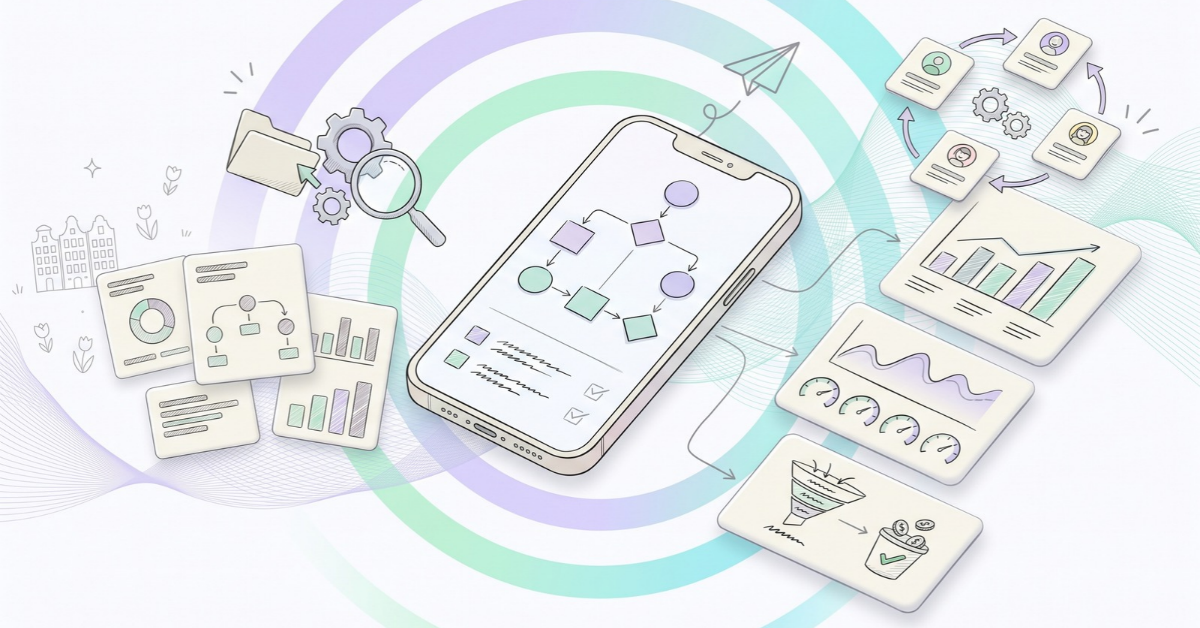
App ad reporting is almost always delayed because mobile attribution requires multiple data points to align before a conversion can be confirmed. Attribution platforms like AppsFlyer or Singular need to match an ad click or impression to an app install and then to any in-app events, a process that can take anywhere from a few hours to several days. On top of that, ad networks like Meta, Google, and Apple Search Ads each apply their own reporting windows and privacy-related aggregation delays. The sections below break down exactly where these delays come from and what you can do about them.
What causes delays in mobile ad reporting data?
Mobile ad reporting data is delayed because confirmed conversions depend on several systems communicating with each other in sequence. An ad network records a click, an attribution platform matches that click to an install, and then in-app events need to fire and be reported before a full conversion path is visible. Each handoff in that chain adds time, and privacy frameworks add further aggregation delays on top.
The main sources of delay are:
- Attribution windows: Platforms wait for a set period (often 7 to 30 days) before closing a conversion window, meaning installs and events from early in a campaign may not appear in your dashboard until the window closes.
- SDK event firing: In-app events only get reported when a user triggers them and the app sends the data to the attribution SDK. If a user installs but does not open the app for two days, that install may sit unconfirmed.
- Privacy-related batching: iOS in particular batches and delays postbacks through Apple’s SKAdNetwork, sometimes holding data for 24 to 72 hours before releasing it.
- Network-side processing: Ad networks process and aggregate their own data before sending it to third-party tools, which introduces an additional lag.
Understanding these layers helps you set realistic expectations for when data will be stable enough to act on.
How does attribution affect when data appears in your dashboard?
Attribution directly controls when a conversion becomes visible in your reporting dashboard. Attribution platforms like AppsFlyer or Singular assign credit to an ad touchpoint only after they receive both the click or impression data from the ad network and the install or event data from the app. Until both signals arrive and are matched, the conversion does not appear in your overview.
The type of attribution model you use also affects timing. Last-click attribution tends to resolve faster because it only requires one touchpoint to be matched. View-through attribution takes longer because impression data needs to be stored and then matched against an install that may happen days later.
Re-engagement and retargeting campaigns add another layer of complexity. Here, the attribution platform needs to determine whether a returning user action was driven by a paid touchpoint or was organic, which requires comparing against historical session data. This matching process can push final numbers back by 24 to 48 hours compared to a standard install campaign.
Why do Apple Search Ads, Meta, and Google report data differently?
Apple Search Ads, Meta, and Google each apply different data collection methods, privacy frameworks, and aggregation rules, which means the same campaign can show different numbers at different times depending on which platform you check. These differences are not errors; they reflect how each network handles privacy compliance and conversion modeling.
Apple Search Ads
Apple Search Ads operates within Apple’s own ecosystem and reports installs relatively quickly, often within a few hours. However, when you are tracking downstream in-app events through SKAdNetwork, Apple batches and delays postbacks by up to 72 hours. The platform also uses conversion value models that require a minimum number of events before data is released, which can make early campaign data look sparse.
Meta
Meta uses a combination of its own pixel, the Meta SDK, and modeled conversions to fill in gaps left by iOS privacy restrictions. This means some of the numbers you see in Meta Ads Manager are estimates based on statistical modeling rather than directly observed events. Meta also applies a 7-day click and 1-day view attribution window by default, and it can take up to 72 hours for conversion data to fully populate after an event occurs.
Google’s reporting is generally faster for Android campaigns because Android does not apply the same SKAdNetwork restrictions as iOS. For iOS campaigns run through Google, data flows through Apple’s privacy framework and inherits the same delays. Google also uses data-driven attribution on some campaign types, which means it redistributes credit across multiple touchpoints retroactively, causing numbers to shift over time even after a campaign ends.
What is the difference between real-time and delayed ad reporting?
Real-time ad reporting shows data as it is recorded, without waiting for attribution windows to close or privacy frameworks to release batched data. Delayed ad reporting reflects confirmed, matched conversions after all the necessary signals have been collected and processed. Real-time data is faster but less accurate; delayed data is slower but more reliable for decision-making.
Most attribution platforms give you access to both. Real-time views are useful for spotting technical issues quickly, such as a tracking link that is broken or a campaign that stopped delivering. They are not reliable for evaluating performance because a large share of conversions will still be unconfirmed.
Delayed or “finalized” reporting is what you should use when comparing channels, evaluating cost per paying user, or deciding whether to scale a campaign. Acting on real-time data too early is one of the most common reasons app marketers make poor budget decisions. A campaign that looks unprofitable on day one may look very different after its attribution window closes.
How long should you wait before acting on app campaign data?
For most app campaigns, you should wait at least 3 to 7 days before making optimization decisions, and up to 14 days if your key conversion event is a purchase or subscription that users typically complete later in their journey. Acting on data before attribution windows have closed means you are reacting to incomplete information.
A practical framework for deciding when to act:
- Day 1 to 2: Check only for delivery issues, creative fatigue, or tracking errors. Do not adjust bids or budgets based on conversion data.
- Day 3 to 5: Install-level data is typically stable enough to assess volume and cost per install. Avoid making decisions about in-app events yet.
- Day 7: For most campaigns, the 7-day click window has closed and you have a reliable picture of install performance. This is when you can start comparing channels meaningfully.
- Day 14 or beyond: If your target event is a paying user or a subscriber, wait until you have enough data across the full conversion path before scaling or pausing.
The right waiting period also depends on your campaign volume. Low-volume campaigns need more time to accumulate statistically meaningful data before any signal is trustworthy.
How can you reduce the impact of reporting delays on campaign decisions?
You can reduce the impact of reporting delays by building your decision-making process around finalized data windows, using a single attribution source of truth, and setting up your dashboards to clearly distinguish between confirmed and unconfirmed conversions. The goal is not to eliminate delays, but to stop making decisions before data is ready.
Practical steps that make a real difference:
- Use one attribution platform as your source of truth. Whether you use AppsFlyer or Singular, pull all channel performance into one place rather than comparing native dashboards across Meta, Google, and Apple Search Ads separately. Native dashboards each count conversions differently, which distorts your app ad spend overview and makes it impossible to identify which channel actually converts.
- Set a data review cadence that matches your attribution window. If your window is 7 days, review campaign performance weekly rather than daily. Daily reviews of incomplete data lead to premature optimizations.
- Separate your reporting views. Keep a real-time view for technical monitoring and a finalized view for performance decisions. Do not mix the two.
- Define your key conversion event clearly before launch. The further down the funnel your target event is (for example, a first purchase rather than a registration), the longer you need to wait before data is stable. Define this upfront so your team knows the review timeline.
- Use cohort-based reporting. Instead of looking at total conversions per day, look at cohorts by install date. This gives you a cleaner view of how users acquired on a specific day are converting over time, which is far more useful than a daily total that keeps changing.
Managing reporting delays well is ultimately about process as much as tooling. When your team has clear rules about when data is ready to act on, you make fewer reactive decisions and more confident ones.
At Wuzzon, we work with clients every day on exactly these challenges, from setting up clean attribution through AppsFlyer or Singular to building reporting structures that give you a reliable app ad spend overview across all channels. If your reporting feels too slow or too fragmented to make confident decisions, our app growth stack services are designed to bring that clarity. You can also talk to one of our specialists to get a practical view of where your current setup might be losing signal.
Frequently Asked Questions
Can I speed up data processing by switching attribution platforms?
Switching attribution platforms will not eliminate reporting delays because the core sources of lag — SKAdNetwork batching, ad network processing, and attribution window lengths — are imposed by Apple, Meta, and Google, not by your attribution tool. What a well-configured platform like AppsFlyer or Singular can do is reduce internal processing time and give you cleaner, faster access to the data that is available. If your current setup feels slow, the issue is more likely a misconfigured SDK, inconsistent postback settings, or a fragmented reporting structure than the platform itself.
What should I do if my attribution data and my ad network data never seem to match?
Discrepancies between your attribution platform and native ad network dashboards are normal and expected, because each counts conversions using different methodologies, windows, and identity signals. The key is to stop trying to reconcile them and instead commit to one source of truth — your attribution platform — for all performance decisions. Use native dashboards only for delivery monitoring (spend, impressions, reach) and rely on your attribution platform for install and event-level data. Documenting the expected variance for each channel helps your team avoid false alarms when numbers differ.
How do reporting delays affect automated bidding strategies on Meta and Google?
Reporting delays can significantly disrupt automated bidding strategies because algorithms like Meta’s Advantage+ or Google’s tROAS rely on fresh conversion signals to optimize delivery. When data is delayed or sparse — especially on iOS due to SKAdNetwork batching — the algorithm may enter a prolonged learning phase, make poor bid decisions, or underdeliver. To mitigate this, use broader optimization events higher in the funnel (such as app opens or registrations) during the learning phase, and only switch to deeper events like purchases once you have sufficient daily conversion volume to feed the algorithm reliably.
Is cohort-based reporting difficult to set up, and where should I start?
Cohort-based reporting is available natively in both AppsFlyer and Singular and does not require custom engineering to get started. Begin by grouping users by their install date and tracking how their conversion rates on your key event develop over 7, 14, and 30 days. This immediately gives you a more stable view of campaign performance than daily totals, which fluctuate as attribution windows close. Most teams find that switching to cohort views is the single highest-impact reporting change they can make without touching their technical setup.
What is the biggest mistake app marketers make when dealing with delayed data?
The most common and costly mistake is pausing or scaling campaigns based on day-one or day-two conversion data before attribution windows have had time to close. A campaign that appears to have a high cost per install on day two may look entirely efficient by day seven once delayed postbacks and matched conversions are counted. Establishing a written decision framework — specifying exactly which metrics you will review on which day — removes the temptation to react prematurely and protects campaigns from being incorrectly optimized during their most critical early phase.
How do I know which conversion event to optimize for given that deeper events take longer to report?
Choose your optimization event based on the minimum volume threshold your ad network needs to exit the learning phase — typically around 50 conversions per week per ad set on Meta, and a similar range on Google. If your target event is a purchase or subscription that generates fewer than 50 conversions per week, optimize for a higher-funnel proxy event (such as a tutorial completion or account registration) that correlates strongly with downstream revenue. Once volume scales, you can shift optimization to the deeper event. Mapping this correlation in advance, before launch, is what separates campaigns that scale efficiently from those that stall in perpetual learning.
Do these reporting delays apply equally to Android and iOS campaigns?
No — Android campaigns generally experience shorter and more predictable reporting delays because Google Play does not impose SKAdNetwork-style privacy restrictions. Android installs and in-app events are typically visible within a few hours through your attribution platform, making optimization cycles faster. iOS campaigns are subject to Apple’s SKAdNetwork postback delays of up to 72 hours, conversion value thresholds, and limited signal granularity, which means iOS data requires longer waiting periods before it is stable enough to act on. If you run campaigns across both operating systems, it is worth maintaining separate review cadences for Android and iOS rather than treating them as a single data set.
Related Articles
- 6 questions to ask before renewing your app tracking contract
- 4 signs you're locked into the wrong app tracking vendor
- How do I audit my app's tracking and attribution setup?
- Why did my app installs drop suddenly?
- Why is it hard to compare ad channels for app campaigns?
- Why doesn't my ROAS match my actual revenue?
- How do you advertise an app to compete with market leaders?
- What is the difference between iOS and Android A/B testing options?
- 5 app store keyword research tools compared
- How long does app store optimization take to show results?

 EN
EN  NL
NL