

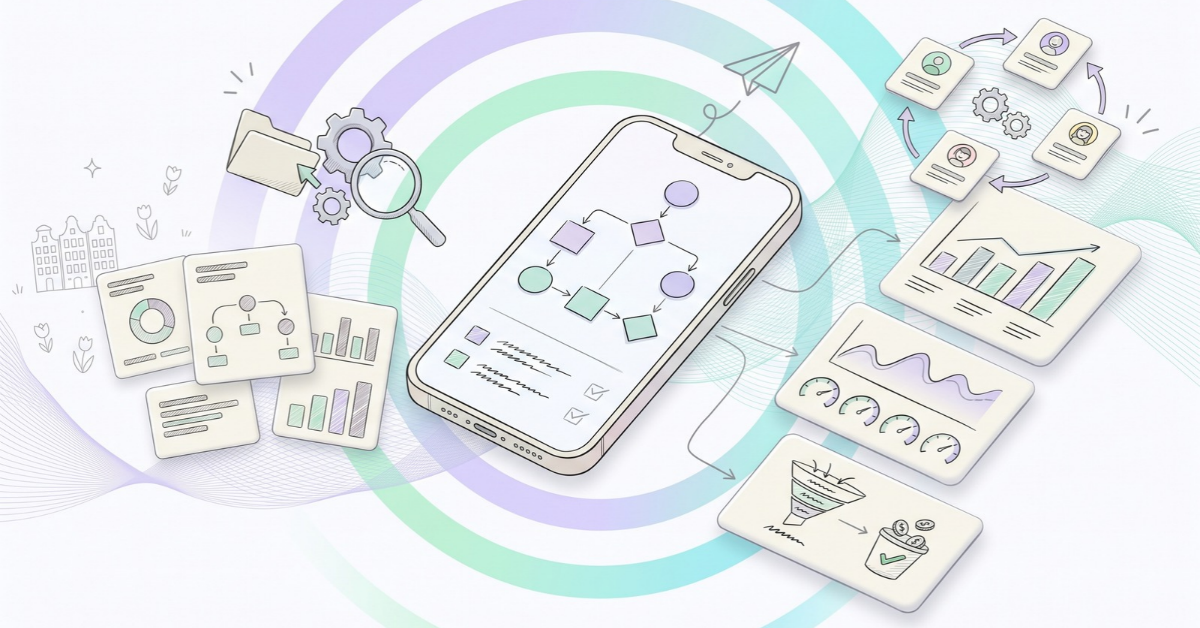
Your app might be losing thousands of potential downloads every month without you even knowing it. An App Store Optimization audit reveals exactly where your app stands in the competitive mobile marketplace and identifies the specific areas holding back your growth. By systematically reviewing your app’s performance metrics, listing elements, and competitive positioning, you can uncover hidden opportunities that transform your app’s visibility and conversion rates. Here’s how to conduct a thorough ASO audit that delivers actionable insights for sustainable app growth.
1. Analyze your current app store performance metrics
Start your audit by gathering comprehensive data about your app’s current performance across both iOS and Android platforms. Focus on key performance indicators that directly impact your app’s success: download rates, conversion rates from impressions to installs, keyword rankings, and user ratings.
Your conversion rate tells you how effectively your app store listing persuades visitors to download your app. A healthy conversion rate typically ranges from 15–30%, but this varies significantly by category and market. Track your keyword rankings for both branded and non-branded terms to understand your organic visibility. Don’t forget to monitor your app’s rating and review velocity, as these factors heavily influence both user trust and app store algorithms.
Document your current position relative to direct competitors in your category. This baseline data becomes the foundation for measuring improvement after implementing optimization changes. Pay particular attention to seasonal trends and any correlation between marketing campaigns and organic performance spikes.
2. Evaluate your app store listing elements
Your app store listing serves as your primary conversion tool, so every element needs careful examination. Begin with your app title and subtitle, ensuring they clearly communicate your app’s value proposition while incorporating relevant keywords naturally. Your app title carries the most weight for both user understanding and search rankings.
Review your app description for clarity, keyword integration, and compelling benefit statements. The first few lines are particularly important since they appear in search results and above the “read more” fold. Examine your visual assets with fresh eyes: does your app icon stand out in search results? Do your screenshots effectively demonstrate your app’s core features and benefits?
Assess your app preview video if you have one, or consider whether adding one would improve your conversion rate. Each visual element should work together to tell a cohesive story about why users need your app. Visual consistency across all elements reinforces your brand and builds trust with potential users.
Understand platform-specific metadata requirements
A thorough app store optimization audit must account for the fact that iOS and Google Play use fundamentally different metadata structures — and optimizing without understanding these differences means leaving ranking potential on the table. Each platform indexes specific fields, enforces distinct character limits, and responds differently to keyword placement strategies.
iOS App Store metadata fields
App name (30 characters): The app name is the strongest ranking signal on iOS. Every character counts, so prioritize your highest-value keyword alongside your brand name. Avoid filler words that consume space without contributing to indexation.
Subtitle (30 characters): The subtitle carries the same algorithmic weight as the keyword field, making it one of the most underutilized ranking opportunities. Use it to target a secondary keyword cluster that complements — but does not repeat — the terms in your app name.
Keyword field (100 characters): The keyword field is comma-separated with no spaces after commas (e.g., fitness,tracker,workout). Critically, iOS does not index your long description for search, so this field, combined with the name and subtitle, represents your entire indexable keyword surface. Repeating keywords across the name, subtitle, and keyword field wastes indexation space and should be avoided — use each field to cover distinct terms.
Google Play metadata fields
App title (30 characters): Like iOS, the title is the primary ranking signal. Include your most important keyword as close to the beginning as possible while keeping the title readable and brand-consistent.
Short description (80 characters): The short description is indexed by Google’s algorithm and appears prominently in search results. Use it to reinforce your core keyword theme with natural, benefit-driven language.
Long description (4,000 characters): Unlike iOS, Google Play indexes the full long description for search. Keyword repetition across the short description and long description can reinforce relevance and improve rankings — aim for natural repetition of primary and secondary keywords throughout the copy rather than forced keyword stuffing.
Side-by-side platform comparison
| Field | iOS App Store | Google Play |
|---|---|---|
| App name / title | 30 characters — strongest ranking signal | 30 characters — strongest ranking signal |
| Subtitle / short description | 30 characters — equal weight to keyword field; indexed | 80 characters — indexed by algorithm |
| Keyword field | 100 characters — comma-separated, no spaces; indexed | No dedicated keyword field |
| Long description | Not indexed for search | 4,000 characters — fully indexed |
| Keyword repetition logic | Avoid repetition across fields — wastes indexation space | Repetition across fields can reinforce keyword density |
3. Research competitor strategies and market positioning
Competitive analysis reveals opportunities you might have missed and helps you understand what works in your specific market segment. Identify your top 5–10 direct competitors and systematically review their app store listings, keyword strategies, and visual approaches.
Pay attention to how competitors position themselves differently from each other. Look for gaps in the market where your app could claim unique positioning. Analyze their keyword strategies by examining their titles, subtitles, and descriptions for patterns. Notice which visual styles and messaging approaches appear most frequently, as this indicates what resonates with your shared target audience.
Document pricing strategies, feature highlights, and user review themes across competitor apps. This research helps you identify differentiation opportunities and understand user expectations in your category. Remember that successful competitors have likely tested their approaches extensively, so their strategies offer valuable market insights.
Evaluate your localization coverage
Apps that expand into localized markets can significantly grow their addressable user base without relying on paid acquisition — making ASO localization one of the highest-ROI levers available during an audit, and one of the most frequently overlooked.
Metadata localization goes beyond simple translation. The App Store supports over 40 locales, and each has its own independent metadata fields — meaning you can target entirely different keyword sets per market. Effective app store listing localization requires cultural adaptation of your app title, subtitle, description, and keyword field for each target locale, not just a language swap. Machine-translated metadata consistently underperforms native-language copy and should be flagged as a priority fix whenever it is identified during the audit.
Visual localization is equally important. Screenshots and preview video text overlays should reflect the local language, cultural references, and device preferences of each target market. A screenshot set optimized for a US audience will rarely resonate equally with users in Japan or Brazil, and leaving visuals unlocalized limits conversion rates even when metadata has been adapted.
Localization gap analysis is a practical audit step that delivers fast results. Review your analytics to identify which markets are generating organic traffic or downloads without a localized listing in place. These markets represent immediate growth opportunities — the demand already exists, and adding localized metadata requires minimal development effort. Prioritize these gaps in your action plan based on download volume and market size.
4. Create your ASO improvement action plan
Transform your audit findings into a prioritized roadmap that balances quick wins with long-term strategic improvements. Start by categorizing opportunities into immediate fixes, medium-term optimizations, and ongoing testing initiatives. Quick wins might include updating your app description or refreshing outdated screenshots, while long-term strategies could involve comprehensive keyword research or complete visual redesigns.
Establish a testing framework for implementing changes systematically rather than making multiple simultaneous updates. This approach helps you measure the impact of individual optimizations and learn what works best for your specific audience. Set up tracking systems to monitor how each change affects your key performance indicators.
Consider the technical requirements and approval processes for both app stores when planning your timeline. Some changes require app updates, while others can be implemented immediately through your developer console. Prioritize changes based on potential impact, implementation difficulty, and resource requirements to maximize your optimization efforts.
Turn your audit insights into app growth results
The real value of your ASO audit emerges when you systematically implement your findings and establish ongoing monitoring processes. Your audit has likely revealed multiple improvement opportunities, but success comes from consistent execution rather than perfect planning. Focus on implementing changes methodically while measuring their impact on your app’s performance.
Remember that App Store Optimization requires continuous attention as market conditions, competitor strategies, and user preferences evolve constantly. Set up regular review cycles to assess your progress and identify new optimization opportunities. The mobile app marketplace rewards apps that consistently refine their approach based on data and user feedback.
What specific insight from your audit will you implement first to start improving your app’s performance?
Frequently Asked Questions
How often should I conduct an ASO audit for my app?
Perform a comprehensive ASO audit every 3-6 months, with lighter monthly reviews of key metrics. Major platform updates, significant competitor changes, or performance drops warrant immediate audits. Regular monitoring helps you stay ahead of market shifts and maintain optimal performance.
Does ASO work differently on iOS versus Google Play?
Yes, the two platforms use different algorithms and metadata structures, and understanding these differences is essential for platform-specific audit decisions. On iOS, the app name, subtitle, and keyword field each carry equal indexation weight, and keyword repetition across these fields wastes coverage rather than reinforcing it. On Google Play, the short description and long description are both indexed, and keyword repetition across fields can reinforce relevance and improve rankings. A key distinction is that iOS does not index the long description for search at all, while Google Play indexes the full 4,000-character description — meaning your iOS ASO vs Android ASO strategies should differ significantly in how you allocate keywords across fields.
What tools do I need to conduct an effective ASO audit?
Essential tools include App Store Connect and Google Play Console for native analytics, plus third-party platforms like App Annie, Sensor Tower, or Mobile Action for competitive intelligence. Free tools like Google Trends and keyword research tools can supplement your analysis on a budget. Most ASO platforms also include built-in metadata character limit checkers, which are essential for ensuring your title, subtitle, and keyword fields comply with platform-specific limits before submission.
My conversion rate is below 15% – what should I fix first?
Start with your app icon and first screenshot, as these create the strongest first impression in search results. Then optimize your app title for clarity and value proposition. These visual elements have the highest impact on conversion rates and can show results within days of implementation.
Should localization be part of my ASO audit?
Yes — if your app is available in multiple countries, auditing your localization coverage is one of the highest-impact steps you can take. Each locale in the App Store has independent metadata fields, meaning you can target entirely different keyword sets per market rather than relying on a single global listing. Review your analytics to identify which markets are generating downloads without a localized listing in place, as these represent immediate growth opportunities with minimal development effort. Keep in mind that machine-translated metadata consistently underperforms native-language copy, so any auto-translated listings should be flagged as a priority fix in your ASO localization strategy.
How do I know if my keyword strategy is working?
Track your rankings for target keywords weekly and monitor organic download attribution in your analytics. Look for gradual ranking improvements over 2-4 weeks after keyword optimizations. Successful keyword strategies show increased impressions and maintained or improved conversion rates.
Should I copy successful competitors' strategies exactly?
Use competitor analysis for inspiration and market insights, but avoid direct copying. Instead, identify what makes their approach successful and adapt those principles to your unique value proposition. Differentiation often drives better results than imitation in crowded app categories.
What's the biggest mistake apps make during ASO audits?
Making multiple changes simultaneously without proper testing frameworks. This makes it impossible to measure which optimizations actually work. Implement changes one at a time or in small, related groups, allowing 2-3 weeks between major updates to accurately assess impact.
How long does it take to see results from ASO improvements?
Visual changes like screenshots and descriptions can impact conversion rates within 24-48 hours. Keyword ranking improvements typically take 2-4 weeks to stabilize. Significant organic growth usually becomes apparent within 30-60 days of consistent optimization efforts.
Related Articles
- 6 ways to find your app's biggest drop-off point
- What is deferred deep linking for apps on iOS?
- 6 ways to future-proof your app measurement setup
- How do I know if an app campaign is actually profitable?
- How do you advertise an app to compete with market leaders?
- Can you advertise an app without using Google Ads?
- What are custom product pages and how do they help advertise your app?
- How do you write an app store description that converts?
- 8 app store review management best practices
- How long does app store optimization take to show results?

 EN
EN  NL
NL