

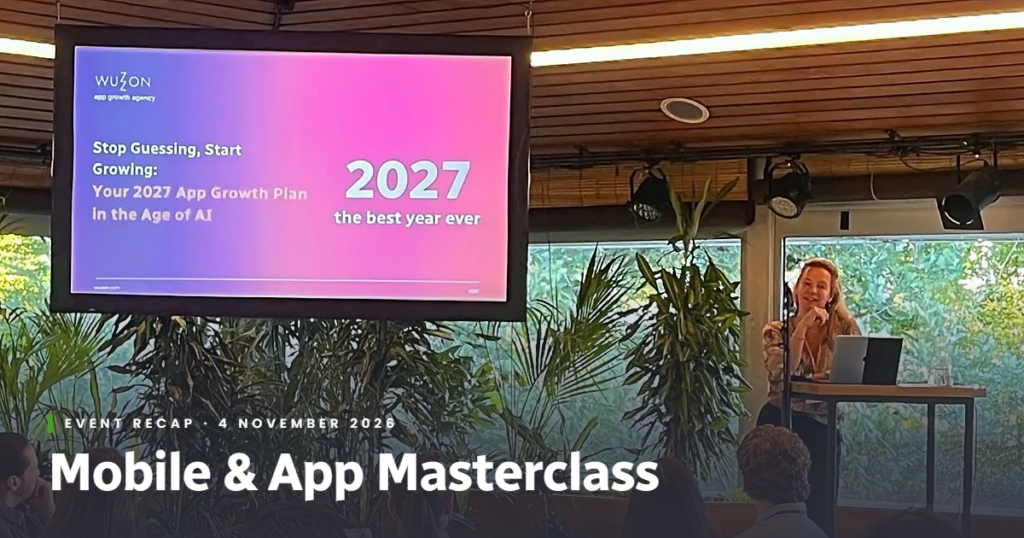
A 2027 app growth plan needs a different starting point than last year’s did. That was the argument our co-founder Louise Verschuren made at the Mobile & App Masterclass in Amsterdam on 4 November, where Wuzzon was an expert sponsor.
Her session, Stop Guessing, Start Growing, carried the same title as last year’s, when the room planned 2026 together. This time the subject was 2027, with one change. Among the questions attendees sent in beforehand, one topic came back again and again: AI.
Why planning matters more this year
Three numbers set up the whole session.
New app releases are up 60% in Q1 2026 against Q1 2025, across the App Store and Google Play. Global downloads grew 0.8% in 2025 against 2024, to close to 150 billion. In-app spending grew 10.6% over the same period, to 167 billion dollars.
So far more apps are competing for a pool of users that has barely grown. But people are spending more inside the apps they keep. The conclusion is not that the market is closing, it is that users will pay when an app gives them real value, and that value is the thing AI cannot copy for you.
If everyone reaches for the same tools in the same way, everything starts to look the same. Your brand, your story and your relationship with your users are what survive that.
The five-step 2027 app growth plan
Louise runs annual planning on a five-step structure, borrowed partly from her work as a Scaling Up coach:
- Lessons learned from this year
- Align on the big picture
- Find your North Star for 2027
- Set KPIs for every stage of the funnel
- Set initiatives for every stage of the funnel
The framework has not changed. What has changed is what is possible inside each step.
Step 1: let AI find what your team missed
Lessons learned used to mean a month of manual work: what moved the needle, what surprised you, what quietly drained energy, what your reviews actually say.
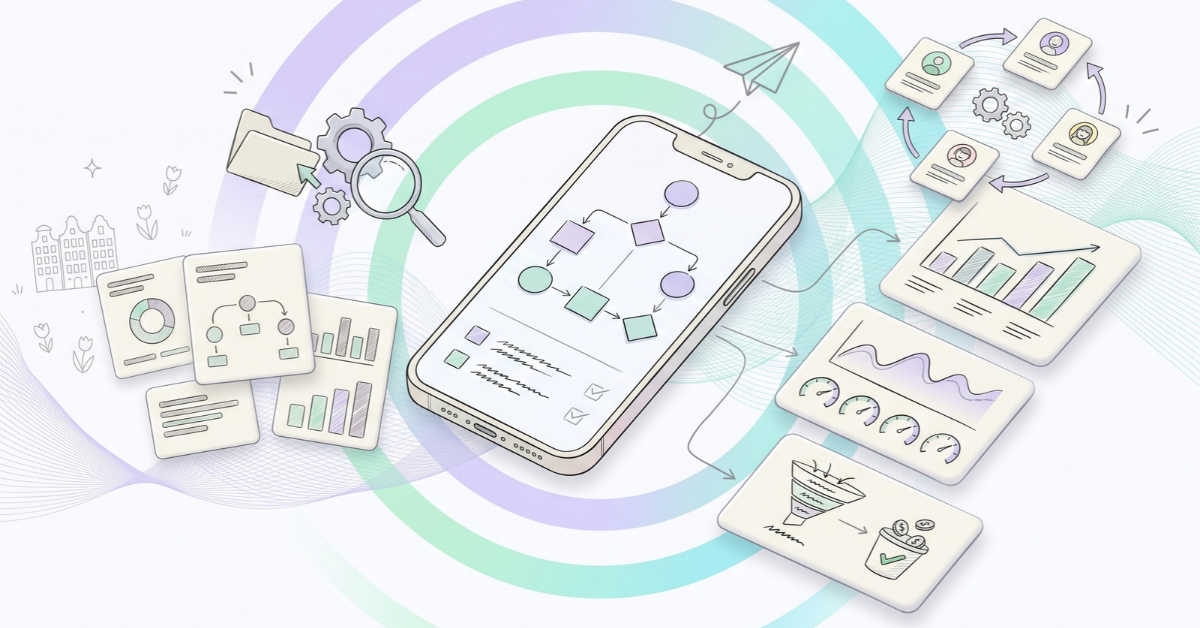
With data streams connected, ad channels, App Store Connect, your MMP and your BI tool, you can interrogate all of it at once. Work that once needed a team of analysts now takes a question.
We run this for Allego, the EV charging app, across campaigns in six countries and four data sources that rarely agree with each other. With everything connected through MCP connectors and anomaly detection running week over week, per market and per channel, we catch things that used to hide until month end, including Meta campaigns spending budget that was never approved.
The point is that you no longer have to wait until December to learn what 2026 taught you. That connected setup is what our App Growth Stack exists to build.
Step 2: a Big Hairy Audacious Goal
Step two is to look far ahead. Scaling Up calls this your Big Hairy Audacious Goal, and it should scare you a little.
Scaling Up frames it as a ten-year goal. In the current climate, ten years feels like a century, so five may serve you better.
Duolingo wants to make the best education in the world universally available. Spotify wants to unlock the potential of human creativity, for artists and for fans. Both are bold enough to outlast any single product decision.
This step matters more now, not less. AI can copy your features in a weekend. It cannot copy your mission or the trust you have built. For us, the version of this is catching smiles: working for clients and apps that make users a little bit happier.
Two questions worth asking: is our mission still bold enough, and did anything we did in 2026 actually bring us closer to it?
Step 3: pick a number that measures value
Louise usually recommends a North Star built around active users, because every part of the framework adds to it. New users, better onboarding, returning users and lower churn all push the same number.
Then put it on the wall, build a dashboard, and make sure everyone knows the definition.
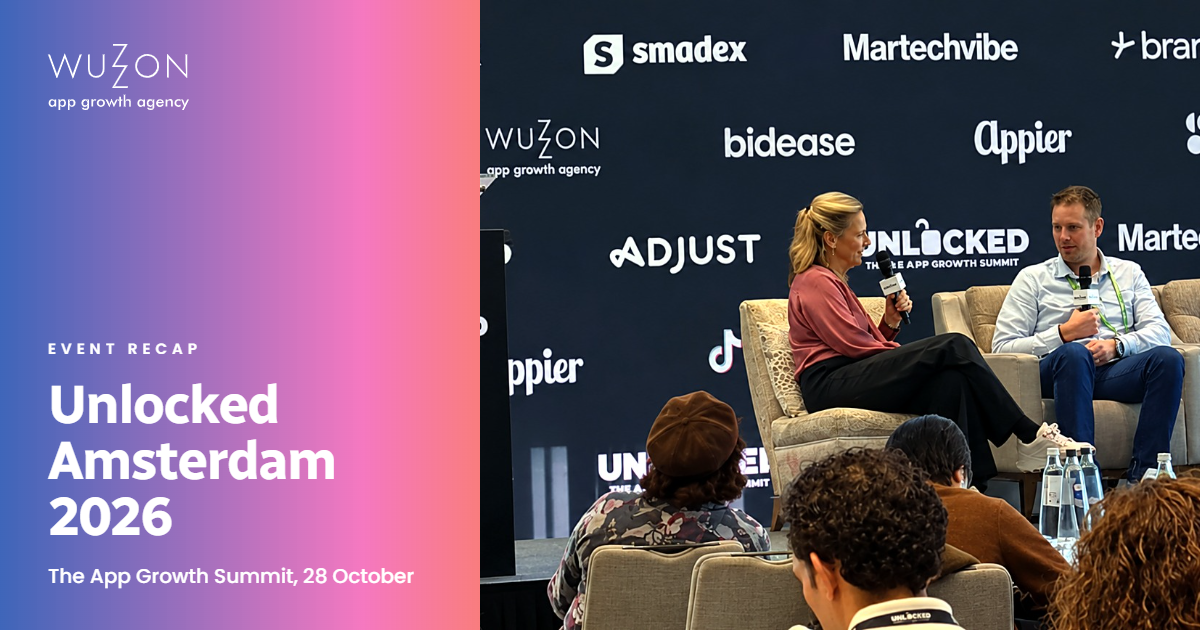
Choosing the wrong number is now more expensive than it used to be. At Unlocked the week before, Louise and Erik Rothengatter of The Wonder Weeks shared a test where four new ad headlines lifted click-through rate by three to seven times, while return on ad spend fell 64% and cost per install tripled. More clicks, the wrong users. The full story is in our subscription app growth recap.
Generating ten new headlines with AI now takes seconds. If your North Star is clicks, AI will cheerfully optimise you straight towards the wrong users.
Steps 4 and 5: one AI initiative per stage
Get users. Discovery is changing fastest here. You can already ask the Gemini app to find an app on Google Play and download it for you, and ChatGPT is opening up its own apps and ads. App Store Optimisation is no longer only about the App Store and Google Play. When someone asks an AI assistant for an app like yours, do you show up? On the paid side, creative is the new targeting and creative fatigue is real, so make creatives at scale but judge them on value.
Activate users. Watch your time to first action and the share of users who complete it. You can now fully personalise that first session from signals you already hold: the campaign, the website, the search intent. Say you run a weight loss app. Did someone arrive from a bikini season campaign or a muscle building one? Make the onboarding match. For e-commerce apps, conversational AI helps people find what they came for faster.
Keep users. Predictive retention replaces the single push to everyone. Let the data tell you who is about to drop off, then find the next best action for each user: sometimes a push, sometimes an in-app message, sometimes nothing at all. Relevance is what matters.
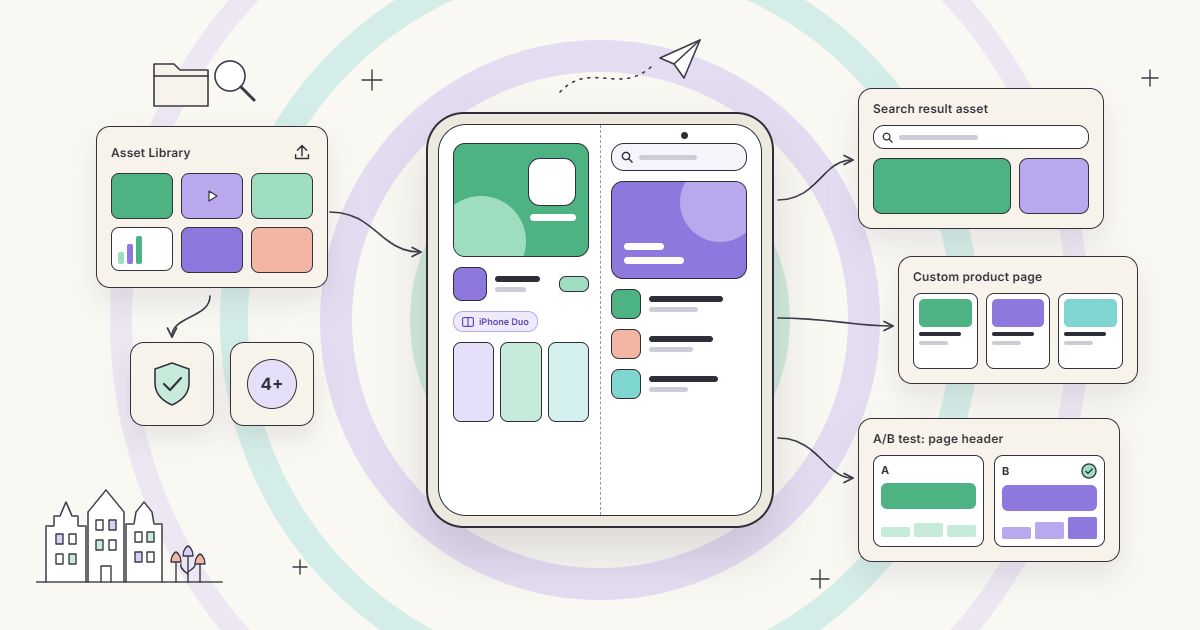
Grow users. Lifetime value, revenue per user, churn. There is enough tooling now to test paywalls and pricing without waiting for an app release, and without depending on your development team for every test.
The top three AI developments to watch in 2027: discovery through AI assistants, creative production at scale, and predictive retention and messaging.
Where AI stops
Louise closed on the limit, and it was the sharpest part of the session.
If everyone uses AI in the same way, we all end up in a race to mediocrity. Same ads, same apps, same advice. The value sits with the people who can judge the output, write the right prompts, and challenge it when it goes wrong. All the history and knowledge a team has built up is what makes AI useful. Without it, AI just helps you make mistakes faster.
Use AI to go faster. Keep the decisions with the people who know your users.
Louise closed on her piano. Fifty days into a first Bach minuet, progress comes one hand at a time, a little every day, with the app telling you exactly where you went wrong. A 2027 plan should feel much the same: small steps, a clear rhythm, honest feedback.
The roundtable question
Louise left the room with one question, and it is a good one to take into your own planning session.
Which one AI initiative goes into your 2027 app plan, and which stage of your funnel should it move?
If you would like a second pair of eyes on that answer, book a consultation and we will work through it with you
 EN
 NL
