

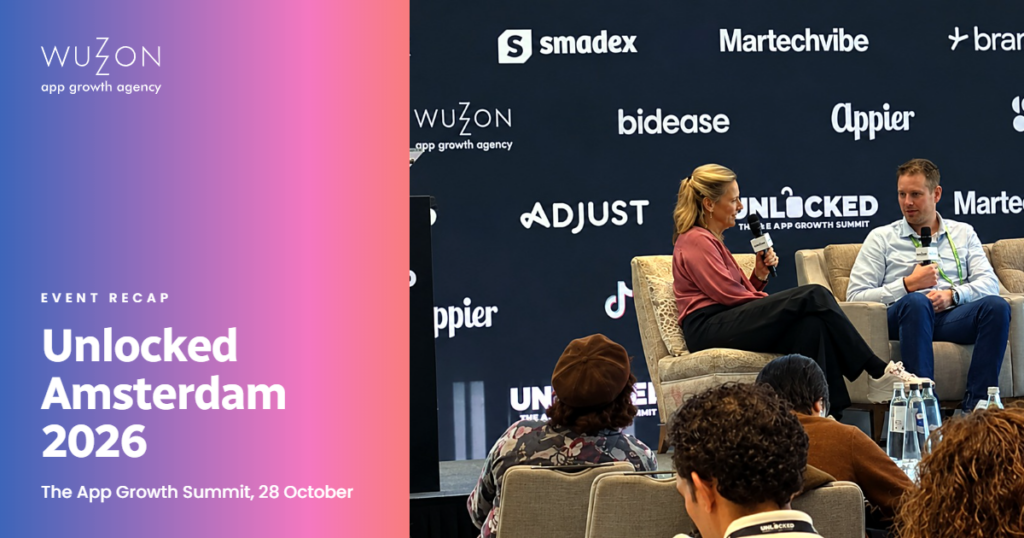
At Unlocked: Mobile & App Growth Summit in Amsterdam, our co-founder Louise Verschuren sat down with Erik Rothengatter, Marketing Manager at The Wonder Weeks, for a fireside chat on subscription app growth. They talked through what it actually took to grow the app, from first install to paying subscriber.
The Wonder Weeks started life as a book. Research into infant development became a bestseller, and the app was built mainly to sell more copies. That’s since changed roles. Revenue used to be roughly 95% book and 5% app. Today it’s close to the reverse.
That shift changes the job completely. You buy a book once and it delivers its value once. A subscription has to earn its place every week, so everything after the install matters more than everything before it.
Here are the three lessons from the session.
1. Judge on predicted LTV, not month-one ROAS
The standard yardstick misreads a subscription model, because renewals arrive long after the acquisition cost does.
Looking only at actual ROAS, The Wonder Weeks would have stopped investing in the US after month three, because that is where the target sits and the actuals were below it. They kept going. Built from renewals, the lifetime-value ROAS clears the target several months in and keeps gaining from there.
The point is not that patience always pays. It is that the wrong metric gives a confident wrong answer. The same rule works in both directions: markets that looked weak on month-one numbers were kept with confidence, and one market would still have been stopped, because the problem there was conversion rather than timing.
The practical change is to judge new markets on predicted ROAS at month three rather than actuals. That requires the renewal data to be connected and modelled properly, which is exactly the setup our App Growth Stack is built to put in place.
2. Test creative like you test bids
The most useful results from the year were the ones nobody predicted.
A simple pie chart ad beat a polished UGC video from a parenting influencer, with 39% lower CPI and 24% higher Day 7 ROAS. Later that month, a deliberately text-heavy ad beat the best-performing ad with 58% higher ROAS and 9% lower CPI, despite getting 18% fewer clicks.
Fewer clicks, more value.
The test that failed taught us more. Four new headlines went onto the winning creative, and CTR rose 3-7x. ROAS dropped 64% and CPI roughly tripled. The headlines did exactly what they were meant to do, get attention, and brought in completely the wrong users.
If you approve creative rather than test it, you’ll keep mistaking clicks for progress. No single winning ad makes the difference. What matters is how quickly you get new concepts live, and how honestly you judge them once they are.
3. Judge paid on what it caused, not what it claims
Attribution tells you who clicked. It doesn’t tell you who would have come anyway.
Brand keywords are where that gap shows most. A one-month brand test in the US showed organic traffic dropping, with paid not winning it back, which pointed to almost complete cannibalisation. Once the test stopped, organic recovered. Germany looks different so far, with enough incrementality to justify keeping brand activity on.
Both are early results until the full incrementality analysis is in, and we’d rather say so. Excluding brand keywords lowers your reported ROAS and raises your real incrementality. Teams that optimise for the reported number slowly end up paying for users they already had.
The bonus lesson
Louise asked Erik what he’d get right first if he started again tomorrow. His answer: improve the value users get after they install before spending more on getting installs. Then get the people who understand your users, the people making the creative and the people buying media talking to each other.
That order is also why our work together started with App Store Optimization before any paid spend, and why the metadata, screenshots and icon testing came before the first campaign went live.
Getting users is only the start.
Thanks to Erik and the whole team at The Wonder Weeks for sharing the detail, including the parts that didn’t work.
If you are growing a subscription app and want us to look at where you’re losong users, book a consultation and we will go through it properly.

 EN
 NL
