
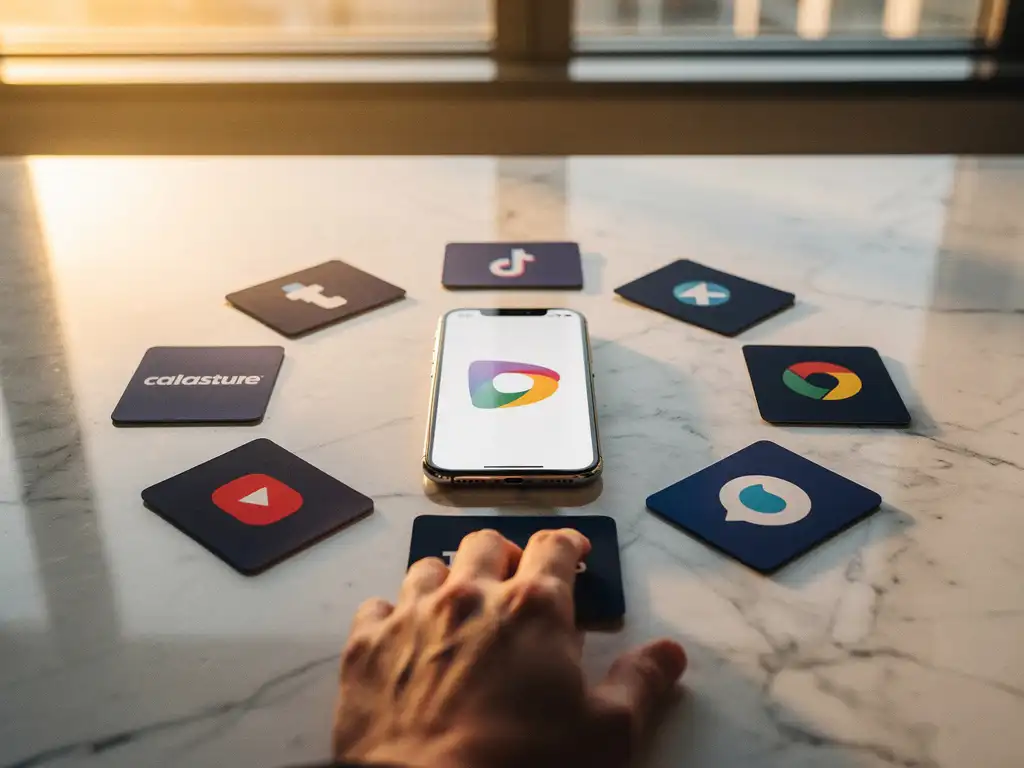
Choosing where to advertise your app directly impacts your user acquisition costs, conversion rates, and overall growth trajectory. The right platform mix can mean the difference between burning through your marketing budget and building a sustainable user base that drives long-term revenue.
Each advertising platform offers unique advantages for app marketers, from Apple Search Ads’ high-intent iOS users to TikTok’s creativity-driven Gen Z audience. The most successful app marketing campaigns combine multiple platforms strategically, matching each channel’s strengths to specific user acquisition goals and budget requirements.
Why Platform Choice Determines Your App’s Success
Different advertising platforms attract distinct user behaviors, demographics, and engagement patterns. A finance app targeting professionals will likely see better results on LinkedIn than on TikTok, while a gaming app might thrive with Meta’s visual formats but struggle with search-based campaigns.
Platform choice also affects your cost structure. Apple Search Ads typically delivers higher-intent users at premium prices, while programmatic networks offer volume at lower costs but with varying quality. Understanding these trade-offs helps you allocate budget efficiently across channels that complement rather than compete with each other.
1: Apple Search Ads for High-Intent iOS Users
Apple Search Ads captures users at the moment they’re actively searching for apps in the App Store. This intent-driven approach delivers some of the highest conversion rates in app marketing, with users already primed to download and engage with new applications.
The platform offers precise targeting based on keywords, demographics, and user behavior within the App Store ecosystem. You can target competitors’ brand terms, relevant category keywords, or broad-match terms to discover new opportunities. Apple’s attribution data provides clear insights into which keywords drive the most valuable users.
Apple Search Ads works best for apps with strong App Store Optimization foundations. Your app’s metadata, screenshots, and reviews directly impact ad performance since users see your store listing immediately after clicking your ad.
2: Google Ads for Cross-Platform Reach
Google Ads extends your reach beyond app stores through Search, Display, YouTube, and Google Play campaigns. This cross-platform approach captures users across different stages of the awareness funnel, from initial discovery to final conversion.
Universal App Campaigns automatically optimize your ads across Google’s entire network, using machine learning to find the best-performing combinations of your creative assets. You provide headlines, descriptions, images, and videos, and then Google tests different combinations to maximize conversions within your target cost per acquisition.
Google’s audience-targeting capabilities let you reach users based on their search history, app usage patterns, and demographic profiles. This data-driven approach helps you find lookalike audiences similar to your best existing users, expanding your reach while maintaining quality.
3: Meta Ads for Social Discovery and Engagement
Meta’s visual advertising formats excel at showcasing app functionality through video demonstrations, carousel ads, and interactive experiences. Users discover apps naturally within their social feeds, making Meta ideal for apps that benefit from social proof and visual storytelling.
The platform’s detailed targeting options combine demographic data with behavioral insights, interest categories, and custom audiences. You can retarget website visitors, create lookalike audiences based on your best users, or target competitors’ audiences to capture market share.
Meta’s creative testing capabilities help you identify which messaging, visuals, and calls to action resonate with different audience segments. The platform’s automated optimization adjusts your campaigns in real time to improve performance and reduce costs.
4: TikTok Ads for Gen Z User Acquisition
TikTok’s algorithm-driven feed creates opportunities for organic-feeling app promotion through native video content. The platform’s young, engaged user base makes it particularly valuable for apps targeting Gen Z and millennial demographics.
Creative formats like Spark Ads let you amplify organic content that’s already performing well, while TopView ads guarantee maximum visibility by appearing as the first content users see when opening the app. In-feed ads blend seamlessly with organic content, reducing ad fatigue and improving engagement rates.
TikTok’s rapid content consumption means you need compelling creative that captures attention within the first few seconds. Apps that can demonstrate their value quickly through visual storytelling tend to perform best on the platform.
5: What About Programmatic Ad Networks?
Programmatic advertising automates the buying and placement of ads across thousands of apps and websites, offering massive scale at competitive prices. These networks use real-time bidding to place your ads in front of relevant users across the mobile ecosystem.
The main advantage lies in reach and efficiency. Programmatic networks can deliver millions of impressions quickly, making them useful for apps with large user acquisition targets or limited creative resources. Automated optimization adjusts bids and placements based on performance data.
However, programmatic advertising often sacrifices quality for quantity. User engagement and retention rates may be lower compared to premium platforms, requiring careful monitoring of lifetime value metrics to ensure profitable campaigns.
6: Performance Networks for Guaranteed Results
Performance networks operate on a cost-per-install or cost-per-action model, where you only pay for completed conversions rather than clicks or impressions. This approach reduces risk by guaranteeing specific outcomes within your budget parameters.
These networks typically combine multiple traffic sources and optimization techniques to deliver consistent results at predictable costs. They handle the complexity of managing multiple campaigns across different platforms while providing transparent reporting on user quality and acquisition costs.
Performance networks work particularly well for apps with clear monetization models and established lifetime value benchmarks. The guaranteed-results model helps with budget planning and reduces the uncertainty common in traditional advertising approaches.
7: Influencer Marketing Platforms for Authentic Reach
Influencer marketing platforms connect app marketers with content creators who can authentically showcase app features to engaged audiences. This approach leverages trust and social proof to drive downloads among highly targeted user segments.
Micro-influencers often deliver better engagement rates and more authentic content than macro-influencers, while costing significantly less per campaign. Platforms like AspireIQ and Upfluence help identify influencers whose audiences align with your target demographics and interests.
Success depends heavily on choosing influencers whose content style and audience genuinely match your app’s value proposition. Authentic endorsements from trusted creators can drive both immediate downloads and long-term brand awareness within specific communities.
Build Your Multi-Platform App Marketing Strategy
The most effective app marketing strategies combine multiple platforms strategically rather than relying on a single channel. Start with one or two platforms that align closely with your target audience, then expand based on performance data and available budget.
Consider your app’s unique characteristics when selecting platforms. B2B apps might prioritize LinkedIn and Google Search, while consumer apps could focus on Meta and TikTok. Gaming apps often perform well on programmatic networks, while productivity apps see better results on search-based platforms.
We help app marketers navigate these platform choices through our performance marketing services, combining platform expertise with data-driven optimization to maximize your return on ad spend across multiple channels. The key is to test systematically, measure results accurately, and scale what works while eliminating underperforming campaigns.
Frequently Asked Questions
How much budget should I allocate to each advertising platform when starting out?
Start with 60-70% of your budget on 1-2 platforms that best match your target audience, then allocate 20-30% for testing additional channels. For example, if you have $10,000 monthly, invest $6,000-7,000 in your primary platform (like Apple Search Ads for iOS apps) and $2,000-3,000 testing secondary channels. Once you have 30 days of performance data, reallocate budget toward the highest-performing platforms.
What's the minimum daily budget needed to see meaningful results on each platform?
Apple Search Ads requires at least $50-100 daily for sufficient data, while Google Ads Universal App Campaigns need $100+ daily for machine learning optimization. Meta Ads can work with $30-50 daily budgets, and TikTok Ads typically need $50+ daily. Performance networks often have minimum spends of $1,000-5,000 monthly, while influencer campaigns can start as low as $500-1,000 per campaign depending on creator tier.
How do I know if my app is better suited for search-based or social media advertising?
Apps solving specific problems (productivity, finance, utilities) typically perform better on search-based platforms like Apple Search Ads and Google because users actively seek solutions. Entertainment, lifestyle, and social apps often excel on visual platforms like Meta and TikTok where users discover apps through engaging content. Test both approaches initially, but prioritize search if your app addresses a clear pain point or social if it’s entertainment-focused.
What are the most common mistakes when running multi-platform app marketing campaigns?
The biggest mistakes include using identical creative across all platforms instead of tailoring content to each platform’s format, spreading budget too thin across too many channels without sufficient data, and not setting up proper attribution tracking to measure cross-platform performance. Also, many marketers optimize for installs rather than lifetime value, leading to acquiring low-quality users who don’t engage or monetize effectively.
How long should I test a new advertising platform before deciding to scale or pause?
Give each platform at least 2-4 weeks with consistent daily spending to gather meaningful data, ensuring you’ve generated at least 50-100 installs for statistical significance. For platforms with longer optimization periods like Google’s Universal App Campaigns, allow 4-6 weeks for machine learning to stabilize. Monitor both immediate metrics (install costs, conversion rates) and 7-day retention rates before making scaling decisions.
Should I run campaigns on multiple platforms simultaneously or test them one at a time?
Start with one primary platform to establish baseline performance and understand your app’s conversion funnel, then gradually add 1-2 additional platforms while maintaining sufficient budget for each. Running too many platforms simultaneously makes it difficult to optimize effectively and can lead to budget fragmentation. Once you have proven success on 2-3 platforms, you can expand more aggressively while maintaining focus on your best-performing channels.
How do I track user quality and lifetime value across different advertising platforms?
Implement mobile attribution platforms like AppsFlyer, Adjust, or Branch to track user behavior and revenue by acquisition source. Set up cohort analysis to measure 7-day, 30-day, and 90-day retention rates by platform, and track revenue per user (RPU) to calculate true lifetime value. Create custom dashboards showing cost per install, retention rates, and LTV by platform to identify which channels deliver the most valuable users, not just the most installs.
Related Articles
- 4 reasons cost per app install isn't enough
- Why do users drop off during app onboarding?
- Why do I have too many dashboards for app marketing?
- How does retargeting help you advertise your app?
- What are the most common mistakes when advertising apps?
- When is the best time to ask users for an app review?
- What is promotional text on iOS and how does it work?
- What is the difference between an app subtitle and short description?
- Why does my brand app need an app store optimization strategy?
- How many screenshots should you have on your app store listing?




 EN
EN  NL
NL