

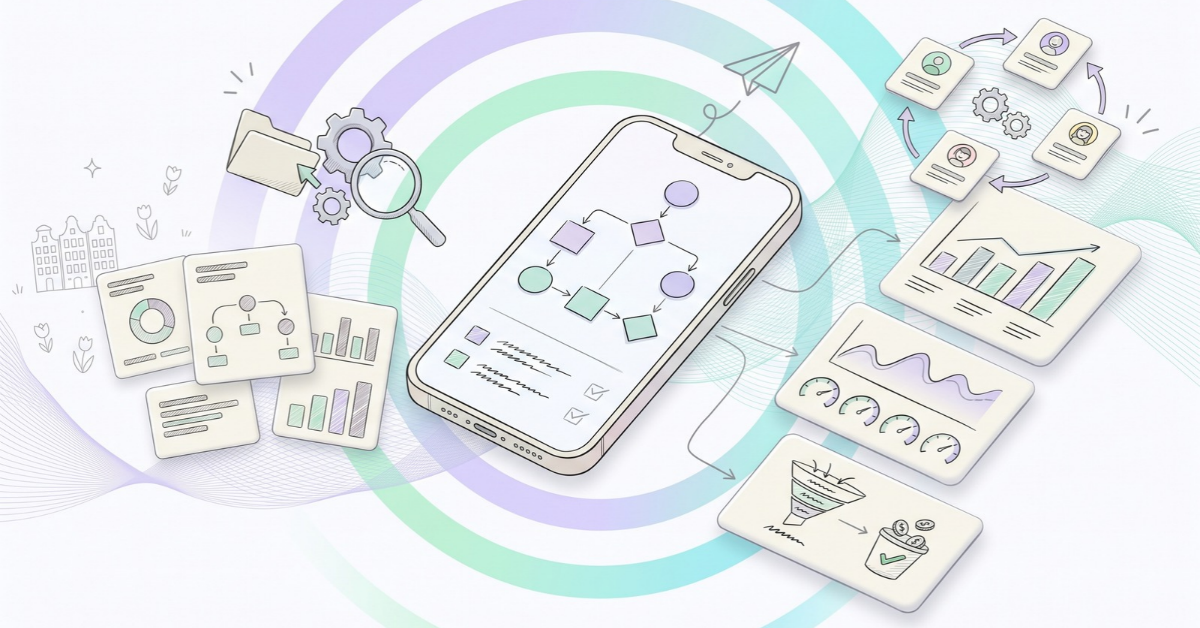
App retargeting helps you promote your app by showing targeted ads to users who have already interacted with it but haven’t completed desired actions, such as making a purchase or subscribing. This powerful advertising strategy focuses your ad spend on warm prospects who are more likely to convert, delivering a significantly higher ROI than broad user acquisition campaigns.
By leveraging user behavior data and sophisticated audience segmentation, retargeting campaigns can re-engage dormant users, guide active users toward conversion, and maximize the lifetime value of your existing user base. Let’s explore how you can harness this strategy to supercharge your app advertising efforts.
What is app retargeting and how does it work?
App retargeting is a digital advertising strategy that targets users who have previously installed or interacted with your mobile app. It works by tracking user behavior through mobile measurement partners like Adjust or AppsFlyer and then serving personalized ads to those users across various platforms and apps.
The process begins when users install your app and perform specific actions, such as browsing products, adding items to their cart, or completing tutorials. These interactions create user segments based on behavioral patterns. Your retargeting platform then identifies these users across different apps and websites, displaying relevant ads designed to bring them back to your app.
Modern app retargeting uses sophisticated attribution models to track users across devices and platforms. When a user sees your retargeting ad and returns to your app, the system can measure which specific ad interaction drove that conversion, providing clear performance data for optimization.
Why is retargeting more effective than regular app advertising?
Retargeting delivers 3–5 times higher conversion rates than standard user acquisition campaigns because it targets users who have already shown interest in your app. These warm prospects require less convincing and are more likely to complete valuable actions, such as purchases or subscriptions.
Regular app advertising focuses on cold audiences who may have never heard of your brand. These campaigns require a significant budget to build awareness and trust before users will download and engage with your app. Retargeting skips this expensive awareness phase by focusing on users who already understand your value proposition.
Cost efficiency is another major advantage. Retargeting campaigns typically achieve a 50–70% lower cost per acquisition compared to prospecting campaigns. You’re not paying to educate new users about your app’s benefits, since retargeted users already have firsthand experience with your product.
Which platforms offer the best app retargeting options?
Meta (Facebook and Instagram) provides the most comprehensive app retargeting capabilities, with detailed audience segmentation, dynamic product ads, and cross-device tracking. Its platform excels at reaching users across multiple touchpoints with personalized creative content.
Google Ads offers powerful retargeting through Google App Campaigns and YouTube, leveraging Google’s vast network reach and machine learning optimization. Its platform particularly excels at reaching users during high-intent moments through search and discovery placements.
Apple Search Ads delivers highly effective retargeting within the App Store ecosystem, targeting users based on their search behavior and app usage patterns. TikTok has emerged as a strong retargeting platform for apps targeting younger demographics, offering engaging, video-first ad formats that drive re-engagement.
Specialized mobile ad networks like ironSource and Unity Ads provide excellent retargeting options for gaming apps, while platforms like Criteo focus on e-commerce app retargeting with dynamic product recommendations.
How do you set up retargeting campaigns for mobile apps?
Setting up app retargeting campaigns requires integrating a Mobile Measurement Partner (MMP) like Adjust, AppsFlyer, or Branch to track user events and create audience segments. Start by defining the specific in-app events you want to track, such as purchases, registrations, or level completions.
Configure your tracking SDK to capture these events with relevant parameters, such as revenue value, product categories, or user progression levels. This data becomes the foundation for creating targeted audience segments. Most platforms require a minimum audience size of 100–1,000 users before campaigns can launch effectively.
Create audience segments based on user behavior patterns. Common segments include users who abandoned their cart, completed onboarding but haven’t made a purchase, or haven’t opened the app in 7–30 days. Each segment should have tailored messaging that addresses its specific stage in the user journey.
Design creative assets that speak directly to each audience segment’s needs. Cart abandoners might see product-specific ads with discount offers, while dormant users might receive content highlighting new features or improvements since their last visit.
What types of users should you retarget for maximum ROI?
Cart abandoners deliver the highest ROI for e-commerce apps since they’ve shown clear purchase intent but need a final push to convert. These users typically convert at 15–25% when retargeted with personalized product ads or limited-time offers.
Lapsed users who haven’t opened your app in 7–14 days represent another high-value segment. They’re familiar with your app but may have forgotten about it or been distracted by competitors. Re-engagement campaigns can recover 10–15% of these users with compelling messaging about new features or exclusive offers.
High-value users who have made purchases but haven’t returned recently deserve special attention. These proven customers often respond well to loyalty programs, exclusive previews, or personalized recommendations based on their purchase history.
Users who completed onboarding but haven’t taken their first meaningful action within your app also offer strong ROI potential. They understand your app’s interface but may need guidance or incentives to reach their first success milestone.
How do you measure app retargeting campaign success?
Return on Ad Spend (ROAS) serves as the primary success metric for app retargeting campaigns, measuring revenue generated per dollar spent on advertising. Successful retargeting campaigns typically achieve a 3:1 to 8:1 ROAS, depending on your app category and audience quality.
Track conversion rates by audience segment to identify your most responsive user groups. Compare these rates against your baseline user acquisition campaigns to quantify retargeting’s effectiveness. Monitor cost per acquisition (CPA) trends to ensure your campaigns remain profitable as you scale.
User lifetime value (LTV) metrics help evaluate long-term campaign success. Retargeted users often show higher engagement and retention rates than newly acquired users, leading to increased LTV even if initial conversion costs appear similar.
Attribution analysis becomes crucial for measuring cross-channel impact. Users might see your retargeting ad on Facebook but convert through a Google search, requiring sophisticated attribution models to accurately measure each campaign’s contribution to overall growth.
If you’re looking to maximize your app’s advertising potential through strategic retargeting campaigns, we offer comprehensive performance marketing services that combine retargeting expertise with data-driven optimization to deliver measurable growth for your mobile app.
Frequently Asked Questions
How long should I wait before retargeting users who haven't opened my app?
The optimal timing depends on your app category and user behavior patterns. For most apps, start retargeting users after 3-7 days of inactivity to catch them before they completely disengage. E-commerce apps can be more aggressive with 1-3 day windows, while utility apps might wait 14-30 days. Test different timing windows and monitor your uninstall rates to find the sweet spot that maximizes re-engagement without appearing intrusive.
What budget should I allocate to retargeting versus user acquisition campaigns?
A balanced approach typically allocates 60-70% of your budget to user acquisition and 30-40% to retargeting campaigns. However, mature apps with large user bases often shift this ratio to 50-50 or even favor retargeting more heavily. Start with a 70-30 split, then gradually increase retargeting budget as you build larger audience segments and prove higher ROI from these campaigns.
Can I retarget users who uninstalled my app?
Yes, but with important limitations. Most platforms allow you to retarget uninstalled users for 30-90 days after uninstallation, depending on their data retention policies. However, these campaigns typically show lower conversion rates and higher costs. Focus on users who uninstalled recently (within 7-14 days) and use compelling messaging that addresses potential reasons for uninstallation, such as new features or resolved issues.
How do I avoid ad fatigue in my retargeting campaigns?
Implement frequency capping to limit ad exposure to 3-5 impressions per user per day across all platforms. Rotate creative assets weekly and create multiple ad variations for each audience segment. Use sequential messaging that evolves based on user engagement – start with gentle reminders, then progress to stronger incentives. Monitor click-through rates closely and refresh creative when performance drops below baseline levels.
What's the minimum audience size needed to start effective retargeting campaigns?
Most platforms require 100-1,000 users minimum for retargeting campaigns, but you need larger audiences for optimal performance. Aim for at least 1,000-5,000 users per segment for stable campaign delivery and meaningful data. If your segments are too small, consider broadening your criteria or combining similar behavioral segments. Facebook typically needs 1,000+ users, while Google can work with smaller audiences of 100-500 users.
How do I handle iOS 14.5+ privacy changes affecting my retargeting campaigns?
Focus on first-party data collection through in-app surveys, email sign-ups, and loyalty programs to build opted-in audience segments. Implement Conversion API and server-side tracking to improve data accuracy. Use broader audience targeting when granular segments become too small, and invest more in creative testing since you’ll have less detailed targeting data. Consider contextual advertising and collaborate with partners who have strong first-party data assets.
Should I exclude recent purchasers from my retargeting campaigns?
Not necessarily – it depends on your business model and campaign objectives. For subscription apps, recent purchasers might be good candidates for upselling or engagement campaigns. E-commerce apps should exclude recent purchasers from acquisition-focused campaigns but can target them with cross-sell or loyalty campaigns after 7-14 days. Create separate campaigns for different post-purchase timeframes rather than blanket exclusions.
Related Articles
- 6 questions to ask before renewing your app tracking contract
- Why does my app link work on Android but not iOS?
- Why does app retargeting open the home screen instead of the product?
- What causes unattributed app installs?
- How do landing pages help you advertise your app effectively?
- How do you advertise an app across iOS and Android?
- 10 expert tips to advertise your app on a tight budget
- What is localized keyword research for app stores?
- What is the difference between app store optimization and SEO?
- How long does app store optimization take to show results?

 EN
EN  NL
NL