

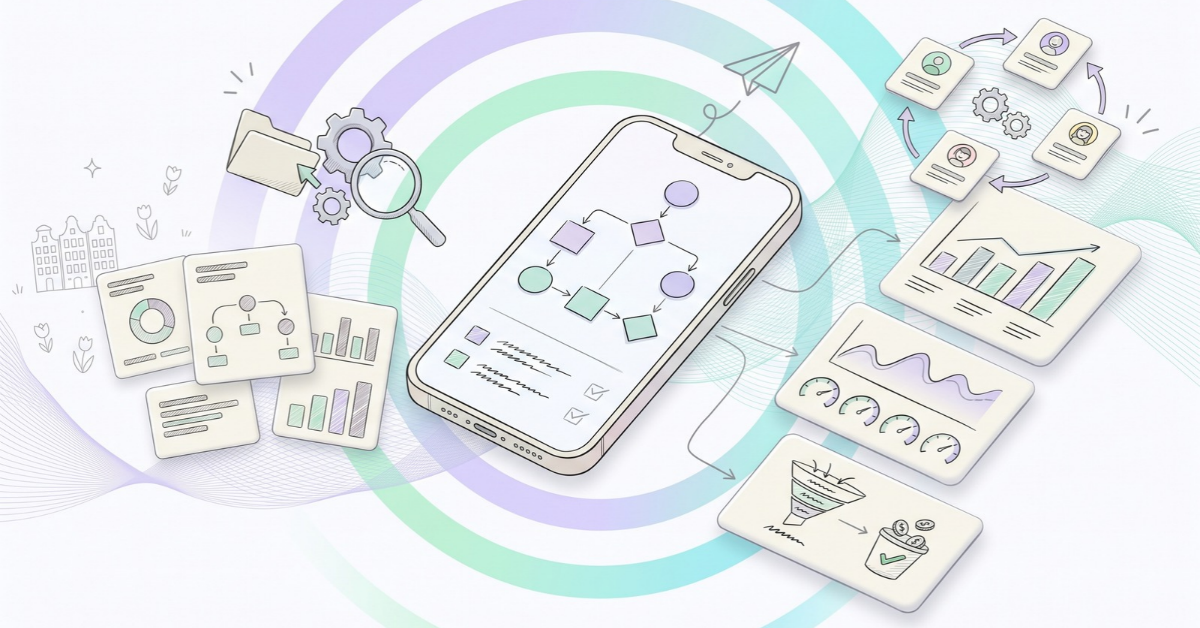
To know which ad channel is actually driving app installs, you need a mobile attribution tool such as AppsFlyer or Singular. These platforms sit between your ad channels and your app, assigning each install to the campaign or network that triggered it. The core challenge is not collecting data, but interpreting it correctly, because platform-reported numbers, attribution logic, and privacy restrictions all pull in different directions. The sections below unpack how attribution works, why numbers diverge, and how to get a more accurate picture of real app ROI.
What tools actually track which ad channel drove an app install?
Mobile measurement partners (MMPs) such as AppsFlyer, Singular, and Adjust are the standard tools for tracking which ad channel drove an app install. They use a combination of device signals, click fingerprinting, and probabilistic matching to connect an install back to a specific campaign, ad set, or network. Without an MMP, you are relying entirely on self-reported data from each platform, which is almost always inflated.
When a user clicks an ad, the MMP records that interaction. When the same user later installs and opens the app, the MMP matches the two events and credits the appropriate source. This data feeds into a single dashboard where you can see cost per install, cost per paying user, and downstream in-app events across every channel in one place, rather than toggling between too many marketing dashboards.
Beyond install attribution, modern MMPs also track post-install behaviour. This means you can see not just which channel delivered the install, but which channel delivered users who actually convert, subscribe, or make a purchase. That distinction is what separates a useful app ad spend overview from raw install counts.
How does mobile attribution actually work?
Mobile attribution works by matching a user’s ad interaction to their subsequent app install using a unique identifier or probabilistic signal. When a user taps an ad, the MMP records the click along with available device data. When the app is opened for the first time, the MMP compares that session data against its click log and assigns credit to the matching source within a defined attribution window.
The matching process relies on a hierarchy of signals. Deterministic matching, which uses a precise device identifier such as an IDFA on iOS or GAID on Android, is the most accurate method. When a precise identifier is unavailable, which is increasingly common after Apple’s App Tracking Transparency framework, the MMP falls back to probabilistic matching using IP address, device model, and timing to estimate the most likely source.
Attribution windows define how long after a click or impression an install can still be credited to that interaction. A seven-day click window is common, meaning an install that happens six days after a user clicked your ad will still be attributed to that campaign. Adjusting these windows changes which channel appears to be the best ad channel for your app, so keeping them consistent across all channels is important for fair comparison.
Why do my ad platform numbers not match my attribution tool?
Ad platform numbers do not match your attribution tool because each platform counts conversions using its own logic, often claiming credit for any install that followed an ad interaction, regardless of what other channels the user also touched. This overlap means that if you add up the installs reported by Meta, Google, and TikTok separately, the total will almost always exceed the actual number of installs recorded by your MMP.
Several specific factors drive this discrepancy. Platforms use their own attribution windows, which may be longer than the ones set in your MMP. View-through attribution, where a platform claims credit simply because a user saw an ad without clicking it, adds further inflation. Privacy-related data gaps, particularly on iOS, mean some installs cannot be matched deterministically, and platforms fill that gap with modeled data that tends to favour their own results.
The practical implication is that you should always use your MMP as the single source of truth for install and conversion numbers. Platform dashboards are useful for managing bids and creative performance, but for understanding which channel actually converts and calculating real app ROI, the MMP data takes precedence.
What’s the difference between last-click and multi-touch attribution?
Last-click attribution assigns 100% of the credit for an install to the final ad interaction before the user opened the app. Multi-touch attribution distributes credit across multiple touchpoints in the user’s journey, such as a TikTok video view, a Google search ad click, and a retargeting banner, based on a defined model. The key difference is how much credit each channel receives and, as a result, how you allocate app ad spend.
Last-click is the default model in most MMPs and is straightforward to implement and explain. Its weakness is that it systematically undervalues channels that introduce users to your app earlier in the journey, such as awareness-stage video campaigns, and overvalues channels that intercept users who were already intending to install.
Multi-touch models such as linear (equal credit to all touchpoints), time decay (more credit to recent interactions), or data-driven (credit weighted by actual conversion influence) give a more complete picture of how channels work together. The trade-off is complexity: multi-touch requires more data, more consistent tracking across channels, and a clearer internal agreement on which model reflects your actual marketing reality. For most app marketers, starting with last-click and layering in multi-touch analysis for high-spend channels is a practical approach.
Which ad channels are hardest to attribute app installs to?
Organic search, influencer content, and connected TV are among the hardest ad channels to attribute app installs to because they either lack a direct clickable link to the app store or operate in environments where tracking identifiers are unavailable or restricted. iOS campaigns more broadly are harder to attribute than Android ones due to Apple’s App Tracking Transparency framework, which limits the availability of deterministic device identifiers.
Meta campaigns on iOS are a specific example where attribution becomes difficult. When users opt out of tracking, Meta relies on its own modeled conversions and Apple’s SKAdNetwork, a privacy-preserving attribution framework that reports aggregated, delayed data rather than individual install events. This makes Singular vs. AppsFlyer reporting comparisons on iOS campaigns particularly challenging because both tools are working with incomplete signals and may interpret them differently.
Owned channels such as email and push notifications can also create attribution confusion if deep links are not set up correctly, causing installs or re-engagements to appear as organic rather than being credited to the campaign that drove them. Proper deep link configuration and consistent UTM tagging across all channels reduce these gaps significantly.
How can incrementality testing reveal true channel impact?
Incrementality testing reveals true channel impact by measuring whether a channel actually caused additional installs that would not have happened without it. Rather than relying on attribution models that assign credit based on proximity to the install, incrementality testing compares a group of users exposed to a campaign against a holdout group that was not, and measures the difference in install rates. This shows the real lift a channel delivers.
The most common method is a geo-based or audience-based holdout test. You pause spend on a specific channel in one region or for one audience segment, keep everything else constant, and observe whether install volume drops. If it does not drop meaningfully, the channel may be capturing installs that would have happened anyway through other routes, which has direct implications for how you view cost per paying user and overall channel efficiency.
Incrementality testing is particularly useful for channels that look strong in last-click attribution but may be intercepting users who were already primed to install. Retargeting campaigns and branded search are common examples where last-click numbers overstate the channel’s true contribution. Running even a single incrementality test on your highest-spend channel can significantly improve how you allocate your app ad spend and interpret combined app ad reports across platforms.
If you want to move beyond surface-level attribution and build a reporting setup that reflects what is actually driving growth, our app growth stack services cover the full measurement and channel strategy layer, from MMP setup to cross-channel analysis. And if you would rather talk through your specific setup first, you can get a free consultation with our team at Wuzzon to work out where the gaps are and how to close them.
Frequently Asked Questions
How do I choose between AppsFlyer, Adjust, and Singular as my MMP?
The right MMP depends on your app’s scale, existing tech stack, and the channels you run. AppsFlyer is the most widely integrated and a safe default for most teams, while Singular stands out for its cost aggregation and marketing analytics layer. Adjust is a strong choice if data privacy compliance and raw data access are priorities. Most MMPs offer a free trial or sandbox environment, so it is worth testing integrations with your key ad partners before committing, since switching later is costly and disruptive.
What is a realistic attribution window to set across all my channels?
A seven-day click window and a one-day view-through window are the most common starting points and work well for most app categories. However, the right window depends on your typical user decision cycle — a gaming app with impulse installs may warrant a shorter window, while a fintech or subscription app with a longer consideration phase might justify extending the click window to 14 or 30 days. The most important rule is consistency: use the same windows across all channels so that no single network gains an unfair attribution advantage.
How does Apple's SKAdNetwork affect my ability to optimise iOS campaigns?
SKAdNetwork (SKAN) reports aggregated, delayed conversion data rather than individual install-level events, which significantly limits the granularity you are used to seeing from Android campaigns. You lose the ability to tie a specific install to a specific creative or audience segment in real time, and postback delays of up to 72 hours slow down optimisation cycles. To work around this, configure your SKAN conversion values carefully to capture the in-app events that matter most early in the user lifecycle, and lean on your MMP’s SKAN reporting dashboard to interpret the aggregated signals as accurately as possible.
What are the most common mistakes app marketers make when setting up their MMP?
The three most common mistakes are: not configuring deep links correctly (causing re-engagement and owned-channel traffic to appear as organic), leaving attribution windows at their default settings without aligning them across all ad partners, and failing to map in-app events beyond the install. If your MMP is only tracking installs and not downstream events like registration, purchase, or subscription, you are missing the data that actually determines whether a channel is profitable. A brief setup audit with your MMP’s support team or a growth partner can catch most of these issues before they distort months of data.
Can I run incrementality tests even if I have a small budget or limited traffic?
Yes, but the test design needs to account for lower traffic volumes to produce statistically meaningful results. A geo-based holdout is often the most practical approach for smaller budgets — pause spend in one lower-priority market for two to four weeks while keeping everything else constant, then compare install rates against a comparable market where spend continued. Avoid running tests during seasonal peaks or alongside major creative changes, as these variables will contaminate the results. Even a rough incrementality signal is more actionable than relying solely on last-click attribution numbers.
How should I handle attribution for users who install the app through the App Store's organic search after seeing a paid ad?
This scenario, often called search harvesting or organic halo effect, is one of the trickier attribution gaps to quantify. If a user sees your TikTok ad but searches for your app directly in the App Store rather than clicking through, that install will typically be recorded as organic by your MMP. The best way to measure this effect is through incrementality testing — pausing paid spend in a region and monitoring whether organic install volume drops proportionally. Apple’s Search Ads also provides some visibility here, since users actively searching for your brand name after seeing a paid ad are a signal worth tracking separately.
What reporting cadence and metrics should I review to make smarter channel allocation decisions?
A weekly review of cost per install (CPI) and cost per paying user (CPPU) by channel is a solid baseline, but the metric that should drive allocation decisions is downstream conversion rate and lifetime value by cohort, not install volume alone. Review cohort data at the 7-day and 30-day marks to see which channels are delivering users who actually retain and monetise. Monthly, revisit your attribution window settings and check for any significant divergence between platform-reported and MMP-reported numbers, as sudden gaps often signal a tracking issue or a change in platform behaviour worth investigating.
Related Articles
- Why did my app installs drop suddenly?
- 6 reasons every ad channel claims credit for the same app install
- How do I know if an app campaign is actually profitable?
- What is the difference between CPI and CPA in app advertising?
- What is frequency capping and why does it matter in app advertising?
- How do you advertise an app on social media platforms?
- What are custom store listings on Google Play?
- What is a good app store rating?
- What is app store metadata?
- 7 common app store optimization mistakes companies make

 EN
EN  NL
NL