

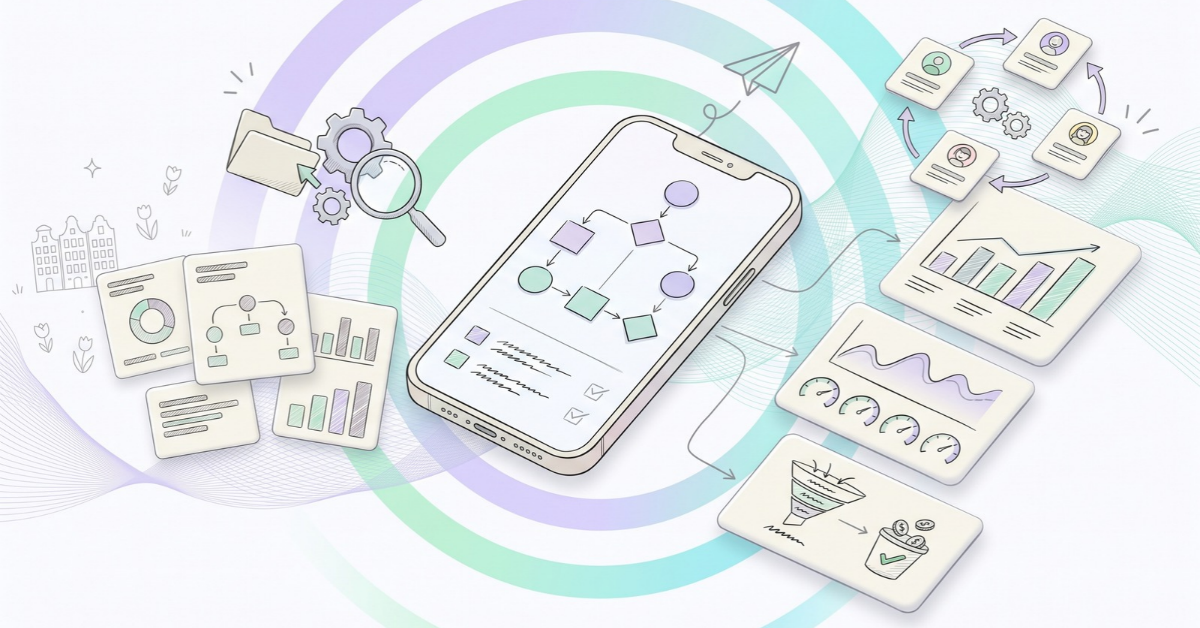
Successfully advertising your app requires more than just launching ads and hoping for the best. With millions of apps competing for attention across iOS and Android, you need a strategic mix of organic growth tactics, paid advertising channels, and retention strategies to drive meaningful results. The most effective app marketing campaigns combine multiple approaches—from App Store Optimization to social media advertising—each targeting different stages of the user journey.
These eight proven methods will help you build a comprehensive advertising strategy that not only attracts new users but also keeps them engaged over the long term. Whether you’re looking to boost organic visibility or scale paid acquisition, each approach offers unique advantages for growing your mobile app.
Why App Advertising Requires a Multi-Channel Approach
App users discover and engage with mobile applications through dozens of different touchpoints throughout their day. Some browse app stores during their commute, others click on social media ads while scrolling, and many discover apps through friends’ recommendations or cross-promotional partnerships.
Relying on a single advertising channel limits your reach and makes you vulnerable to platform changes, algorithm updates, or increased competition. A diversified approach spreads risk while maximizing your chances of reaching users where they’re most receptive to your message. Different channels also serve different purposes in the user journey, from initial awareness to final conversion and retention.
Before You Advertise: Define Your Audience and Set Your KPIs
The most common reason app advertising fails is not a wrong channel choice—it’s a poorly defined audience and unclear success metrics. Before you invest a single dollar in any of the eight methods below, you need a clear picture of who you’re trying to reach and how you’ll measure whether you’re succeeding. Skipping this step means optimizing toward the wrong signals and making budget decisions based on incomplete information.
Taking even a few hours to establish your audience profile and core KPIs will make every subsequent advertising decision sharper, faster, and more defensible. This foundation turns the eight methods that follow from a generic checklist into a set of informed, strategic choices tailored to your specific app and market.
How to Build a User Persona for Your App
Start by identifying the core problem your app solves—stated in one clear sentence. From there, describe the user who has that problem: their age range, preferred platform (iOS or Android), the context in which they’d use your app, and the outcome they’re hoping for. Be specific rather than broad. A fitness app for busy parents of young children is a more actionable persona than “adults who want to get fit.”
Next, research two to three competing apps and read their App Store reviews carefully. Look for recurring complaints and unmet needs—these are gaps your app can speak to directly in its messaging. Finally, document this persona in a one-page brief that your entire team can reference. Every channel you choose and every creative asset you produce should be filtered through this persona to ensure consistency and relevance.
Which KPIs to Track Before Launching Any App Ad Campaign
Defining your key performance indicators before launch prevents you from measuring the wrong things after the fact. Five metrics are essential for any app advertising campaign. Cost Per Install (CPI) tells you what you’re paying to acquire each new user and sets the baseline for evaluating channel efficiency. Cost Per Action (CPA) goes deeper, measuring what it costs to drive a specific in-app behavior—such as a purchase or a completed onboarding step—that actually reflects user intent.
Day-1 and Day-30 retention rates reveal how many users return after their first session and after one month, which are the clearest early signals of product-market fit and onboarding quality. Lifetime Value (LTV) estimates the total revenue a user generates over their relationship with your app, and it’s the number that determines how much you can sustainably spend to acquire them. Finally, churn rate measures the percentage of users who stop using your app over a given period—high churn undermines every acquisition effort, so understanding it early helps you prioritize retention alongside growth. Establish benchmarks for each of these before you launch, and review them consistently as campaigns run.
1: Master App Store Optimization to Grow Organic Installs
App Store Optimization forms the foundation of any app marketing strategy because it improves your visibility where users actively search for solutions. When someone searches for apps like yours, ASO determines whether your app appears in the results and how compelling it looks compared to competitors.
Focus on optimizing your app title, subtitle, and keyword fields with terms your target audience actually searches for. Your app icon, screenshots, and preview videos need to communicate your value proposition within seconds, as these visual elements heavily influence download decisions. Regular A/B testing of these elements helps you understand what resonates with your specific audience and drives higher conversion rates from impressions to installs.
2: Leverage Apple Search Ads for High-Intent iOS User Acquisition
Apple Search Ads places your app at the top of relevant App Store search results, giving you prime visibility when users actively look for apps in your category. This intent-driven advertising typically delivers higher-quality users because they’re already in a discovery mindset when they encounter your ad.
The platform offers two main options: Search Ads Basic provides automated campaign management with a simple setup, while Search Ads Advanced gives you granular control over keywords, audiences, and bidding strategies. Start with broad keyword targeting to identify which search terms drive your best users, then refine your approach based on actual performance data rather than assumptions about user behavior.
3: Scale Reach with Google App Campaigns Across Search, YouTube, and Display
Google App Campaigns automatically distribute your ads across Google Search, YouTube, Google Play, and the Google Display Network, using machine learning to optimize for your chosen conversion goals. This broad reach helps you connect with potential users across multiple Google properties where they spend their time.
The platform works best when you provide diverse creative assets, including images, videos, and text variations, allowing Google’s algorithms to test different combinations and identify top performers. Set clear conversion goals from the start, whether that’s installs, in-app purchases, or specific user actions, so the system can optimize toward outcomes that matter for your business rather than just driving volume.
4: Use Social Media Advertising and Organic Content to Drive App Downloads
Social media advertising excels at reaching users who aren’t actively searching for apps but might be interested in your solution. Each platform attracts different demographics and supports various ad formats, making platform selection and creative strategy critical for reaching your ideal users effectively. The most successful app teams combine paid social campaigns with a consistent organic content presence to build both immediate installs and long-term brand recognition.
Rather than spreading budget across every platform at once, identify where your target audience is most active based on your user persona, test with small budgets, and double down on the channels that deliver quality installs at a sustainable cost. The tactics below give you a concrete starting point for the platforms most relevant to app advertisers.
Facebook and Instagram: Targeting, Stories, and UGC Campaigns
Facebook and Instagram offer some of the most sophisticated audience targeting available for app advertisers, making them well-suited for apps with broad consumer appeal. Run app install campaigns using Custom Audiences built from your existing website visitors or customer lists, then expand reach with Lookalike Audiences that mirror the profile of your best users. This layered targeting approach helps you move beyond broad demographic buckets and reach people who are genuinely likely to engage with your app.
Instagram Stories with direct App Store or Google Play links are particularly effective for driving installs because the full-screen format is immersive and the call-to-action is immediate. Complement paid placements with user-generated content campaigns: encourage existing users to share screenshots, results, or short clips from your app using a branded hashtag. UGC builds social proof organically, and the best submissions can be repurposed as paid creative assets, often outperforming studio-produced ads because they feel authentic to the platform.
TikTok: Short-Form Video and Challenge Formats for App Virality
TikTok’s algorithm rewards content that feels native to the platform, which means app ads that mimic the style and pacing of organic TikTok videos consistently outperform polished, broadcast-style productions. When creating video ads, lead with a strong hook in the first two seconds—a surprising result, a relatable problem, or an unexpected use case—and let the app’s value speak for itself rather than relying on voiceover narration alone. Use the App Install objective in TikTok Ads Manager to optimize delivery toward users most likely to download.
Branded hashtag challenges are a uniquely TikTok mechanic that can generate organic installs at scale. By inviting users to participate in a challenge tied to your app’s core functionality—such as a fitness app challenging users to post a 30-day progress clip—you create a self-sustaining content loop that extends your reach far beyond your paid media spend. Even without a large challenge budget, seeding content through a handful of mid-tier creators who already have engaged followings in your niche can generate meaningful app promotion on TikTok at a fraction of the cost of top-tier influencer deals.
LinkedIn: Reaching Professional and B2B App Users
For productivity tools, enterprise software, or any app targeting professionals by role or industry, LinkedIn Sponsored Content offers targeting precision that no other social platform can match. You can reach users by job title, seniority level, company size, and industry—making it straightforward to put your app in front of, for example, mid-level project managers at technology companies with 50 to 500 employees.
LinkedIn app install campaigns tend to carry a higher cost per install than Facebook or TikTok, so the channel is most justified when your app’s LTV is high enough to absorb that premium. Lead with business outcomes in your creative—time saved, revenue generated, or errors reduced—rather than feature lists. Decision-makers on LinkedIn respond to clear, quantified value propositions, so your ad copy and visuals should speak directly to the professional problem your app solves.
Organic Social Media Content Ideas That Build Community
Paid social drives installs, but organic content builds the community and trust that sustains long-term growth. Any app team, regardless of budget, can produce content that educates, entertains, and converts. Five formats consistently perform well across platforms: short app feature demos that show a specific use case in under 60 seconds; user testimonials or before-and-after results shared with permission; behind-the-scenes development updates that humanize your team and build anticipation for new features; poll questions that invite followers to weigh in on pain points your app addresses; and brief tutorial clips that help existing users get more value from features they may have overlooked.
Posting consistently matters more than posting frequently. A realistic schedule of three to four pieces of content per week, maintained over months, will outperform a burst of daily posts followed by silence. Use your organic content performance—which formats get saved, shared, or commented on—as a signal for which creative angles to test in your paid campaigns.
5: Build Cross-Promotion Partnerships to Tap New User Bases
Cross-promotion partnerships allow you to tap into another app’s established user base, often at lower costs than traditional advertising channels. Look for apps that serve similar audiences but aren’t direct competitors, creating mutually beneficial opportunities.
Effective partnerships go beyond simple app exchanges and include integrated experiences, shared content, or bundled offerings that provide genuine value to users. Document clear success metrics upfront, such as install rates, user quality scores, or lifetime value, to ensure both parties benefit fairly from the arrangement. The best partnerships evolve into long-term relationships that support ongoing growth rather than one-time promotional swaps.
6: Launch a Referral Program to Turn Users into Growth Drivers
Referral programs turn your existing users into active promoters, leveraging social proof and personal recommendations to drive new installs. Users acquired through referrals often show higher engagement and retention rates because they come with built-in social validation from someone they trust.
Design your referral incentives to benefit both the referrer and the new user, creating motivation for sharing while providing immediate value to newcomers. Make the sharing process simple with pre-written messages, easy social sharing options, and clear tracking of referral success. Monitor referral quality closely, as some incentive structures can attract users who game the system rather than genuine advocates for your app.
7: Implement Advanced Attribution Tracking to Optimize Ad Spend
Accurate attribution tracking reveals which advertising channels drive your most valuable users, enabling you to allocate budget toward high-performing sources and optimize underperforming campaigns. Without proper tracking, you’re essentially advertising blind, unable to distinguish between channels that drive quality users and those that generate empty installs.
Implement attribution platforms that track users across devices and touchpoints, providing a complete view of the user journey from first impression to conversion and beyond. Set up custom events that align with your business goals, whether that’s completing onboarding, making purchases, or reaching specific engagement milestones. Regular attribution analysis helps you identify trends, seasonal patterns, and optimization opportunities that improve your overall advertising effectiveness.
8: Improve User Retention to Maximize Your Advertising ROI
User retention directly impacts your advertising return on investment because retained users generate more value over time, justifying higher acquisition costs and enabling more aggressive growth strategies. Apps with strong retention can afford to bid more competitively for new users while maintaining profitable unit economics.
Focus on optimizing your onboarding experience to help new users quickly understand and experience your app’s core value. Implement push notification strategies that re-engage users at optimal times without becoming intrusive, and use in-app messaging to guide users toward valuable actions. Track cohort retention rates to understand how different user acquisition sources perform over time, allowing you to prioritize channels that bring users who stick around and engage consistently.
Scale Your App Growth with Performance-Based Marketing
Successfully advertising your app requires combining these methods into a cohesive strategy that addresses different stages of the user journey. Start with strong App Store Optimization to capture organic demand, then layer in paid channels based on where your target audience spends their time and how they prefer to discover new apps.
At Wuzzon, we’ve helped apps across various industries implement these advertising methods through our comprehensive app growth solutions. Our performance marketing approach focuses on measurable results, ensuring your advertising budget drives real growth rather than just vanity metrics. Whether you need help with ASO, paid user acquisition, or retention optimization, we’re here to help you build a sustainable app growth strategy that delivers lasting results.
Frequently Asked Questions
How much budget should I allocate to each advertising channel when starting out?
Start with 40% of your budget on App Store Optimization and organic growth, 30% on one primary paid channel (Apple Search Ads for iOS or Google App Campaigns for Android), 20% on social media testing across 2-3 platforms, and 10% on partnership development. Once you identify your best-performing channels after 2-3 months, reallocate budget toward the highest ROI sources while maintaining some diversification.
What's the biggest mistake apps make when implementing multi-channel advertising?
The most common mistake is spreading budget too thin across too many channels without proper testing and optimization. Many apps launch on 5-6 platforms simultaneously with small budgets, making it impossible to generate statistically significant data or achieve meaningful scale on any single channel. Focus on mastering 2-3 channels first, then expand once you’ve established profitable campaigns.
How long does it typically take to see results from App Store Optimization efforts?
ASO improvements typically show initial results within 2-4 weeks for keyword ranking changes, but significant organic growth usually takes 2-3 months of consistent optimization. Factors like app category competition, update frequency, and review velocity affect timeline. Track keyword rankings weekly and organic install growth monthly to measure progress, and be prepared to iterate on your ASO strategy based on performance data.
Should I focus on iOS or Android advertising first if I have a limited budget?
Choose based on where your target audience is most active and your monetization model. iOS users typically have higher spending power and engagement rates, making Apple Search Ads effective for premium or subscription apps. Android offers larger global reach and lower competition in many markets, making Google App Campaigns cost-effective for apps targeting broader audiences or international markets. Test both with small budgets if possible, but prioritize the platform that aligns with your user demographics.
How do I know if my user acquisition campaigns are actually profitable?
Calculate your Customer Lifetime Value (LTV) and compare it to your Customer Acquisition Cost (CAC) with a target LTV:CAC ratio of at least 3:1. Track cohort retention rates, average revenue per user, and payback periods by acquisition channel. Set up proper attribution tracking to measure post-install events like purchases, subscriptions, or key engagement actions. If your LTV calculation shows profitability beyond 90 days, you have a sustainable acquisition model.
What's the most effective way to test and optimize creative assets for app advertising?
Start with 3-5 different creative concepts highlighting different value propositions (features, benefits, social proof, etc.), then test variations within your best-performing concepts. For video ads, test different hooks in the first 3 seconds since that’s when most users decide to continue watching. Run A/B tests for at least 7-14 days to account for daily performance fluctuations, and focus on metrics beyond just install rates—track post-install engagement and retention by creative to identify assets that drive quality users.
How can I improve my app's retention rates to maximize advertising ROI?
Focus on three key areas: streamline your onboarding to demonstrate core value within the first session, implement smart push notifications based on user behavior patterns rather than generic schedules, and create habit-forming features that give users reasons to return daily. Track Day 1, Day 7, and Day 30 retention rates by acquisition source to identify which channels bring the most engaged users, then optimize your campaigns to prioritize quality over quantity.
Related Articles
- 5 reasons app users never reach their intended screen
- How does AppsFlyer's reporting dashboard work for app campaigns?
- 4 reasons cost per app install isn't enough
- Why does my app ad open the wrong screen in-app?
- What is the difference between organic and paid app advertising?
- 6 key metrics to track when you advertise your app successfully
- Should startups advertise their app differently than enterprises?
- What are backend keywords on iOS?
- How do keywords affect app store rankings?
- 8 app store review management best practices

 EN
EN  NL
NL