

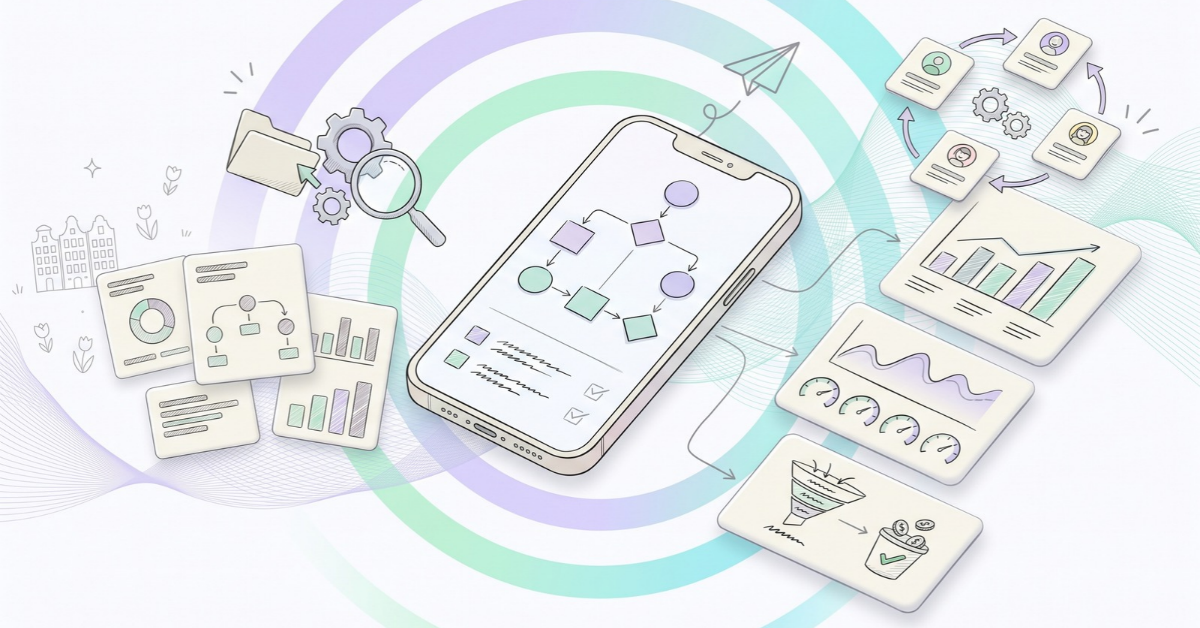
Manual reporting doesn’t fail loudly. It fails slowly, through delayed decisions, mismatched numbers, and a team that spends its best hours maintaining spreadsheets instead of improving performance. If your app ad reporting relies on manual exports, copy-pasted data, or separate dashboards per channel, you are likely leaving growth on the table. Here are four signs that your reporting setup is holding your app back.
When manual reporting quietly kills app growth
The problem with manual reporting is that it feels manageable until it isn’t. Teams adapt, add another tab, build another formula, and the process keeps running. But underneath that routine, real costs accumulate: slower decisions, missed optimisations, and a growing gap between what your campaigns are doing and what you think they are doing.
A solid app ad spend overview should tell you at a glance which channel actually converts, what your cost per paying user looks like across platforms, and where your budget is working hardest. When you have to manually pull that picture together from AppsFlyer, Meta, Google, TikTok, and Apple Search Ads every single time, the picture is always slightly out of date before you even finish building it.
1: Your team spends more time on spreadsheets than strategy
If your growth team’s Monday morning starts with exporting CSVs, aligning column headers, and reconciling totals across platforms, that is a reporting problem disguised as a workflow. Every hour spent formatting data is an hour not spent analysing it, testing creative, or adjusting bids.
This pattern is especially common when teams are running campaigns across multiple channels simultaneously. Combining app ad reports from Meta, Google, TikTok, and Apple Search Ads into a single view manually is time-consuming and error-prone. The more channels you add, the worse it gets.
The right setup automates data aggregation so your team works with a unified, always-current view. When reporting runs itself, your team can focus on what actually moves the needle: identifying which channel drives your best users and acting on that insight quickly.
2: Campaign decisions lag behind actual performance
App reporting that is too slow creates a decision delay that compounds over time. If your data is 24 to 48 hours behind reality, you are optimising based on yesterday’s performance while today’s budget continues to run. In fast-moving paid channels, that gap is expensive.
Real app ROI requires timely data. When you can only review performance weekly because the reporting process takes that long to complete, you lose the ability to react to underperforming creatives, budget overruns, or sudden drops in conversion rate before they cause real damage.
Automated attribution tools like AppsFlyer or Singular are built to close this gap. They pull real-time data from your ad networks and map it to actual in-app behaviour, giving you a live view of cost per paying user by channel, campaign, and creative. The question is not whether to use them, but whether your reporting infrastructure actually takes advantage of what they offer.
3: What happens when your numbers never quite match?
Discrepancies between your ad network data and your mobile measurement partner (MMP) are normal to a degree. But when those gaps are large, persistent, or unexplained, they undermine every decision you make. If Meta reports 500 installs and AppsFlyer reports 380, which number do you optimise toward?
The Singular vs AppsFlyer reporting debate is often less about which tool is better and more about how well each is implemented. Mismatched numbers frequently trace back to attribution window settings, SDK configuration issues, or inconsistent event naming across platforms. When reporting is manual, these discrepancies often go unnoticed or get accepted as normal.
A well-configured MMP with consistent event taxonomy and properly aligned attribution windows gives you a single source of truth. That means your best ad channel for app decisions are based on accurate, comparable data rather than whichever platform’s reporting you happened to trust that week.
4: Scaling campaigns exposes every reporting bottleneck
Manual reporting is survivable at small scale. When you are running two or three campaigns across one or two channels, the process is painful but manageable. The moment you start scaling, adding channels, increasing budget, or running simultaneous creative tests, every inefficiency in your reporting multiplies.
Too many marketing dashboards is a real problem at scale. When each platform has its own interface, its own attribution logic, and its own definition of a conversion, scaling without unified reporting means scaling confusion alongside performance. Teams end up making channel allocation decisions based on whichever dashboard they checked last, rather than a consolidated view of real app ROI.
Scaling also raises the stakes for accuracy. A reporting error that costs you one percent of budget when you are spending modestly becomes a significant problem when your monthly ad spend grows. Automated, integrated reporting is not just a convenience at scale. It is a requirement for making sound budget decisions.
Fix reporting before it caps your app’s growth
If any of the four signs above feel familiar, the fix is not to work harder on your spreadsheets. It is to build a reporting infrastructure that works automatically, pulls from a single source of truth, and gives your team the time and clarity to make better decisions faster.
Start by auditing your current setup: how many platforms are you pulling data from manually, how often does your reporting lag behind actual spend, and where do your numbers regularly disagree? Those answers will tell you exactly where to focus first.
At Wuzzon, we help app teams move from fragmented, manual reporting to a clean, automated growth stack built around accurate attribution and actionable data. If your reporting is slowing down your growth, our app growth stack services are designed to fix that directly. Want to understand what a better setup looks like for your specific app? Talk to one of our specialists and we will take a look together.
Frequently Asked Questions
How do I know which mobile measurement partner (MMP) is right for my app?
The right MMP depends on your app category, the ad networks you run, and the complexity of your in-app event taxonomy. AppsFlyer and Singular are both strong choices, but the deciding factors are usually integration depth with your primary channels, SDK stability, and the quality of their fraud protection. Before committing, map out the specific events you need to track (installs, registrations, purchases, subscriptions) and verify that your shortlisted MMP supports clean attribution for all of them across your active networks.
What is a realistic timeline for migrating from manual reporting to an automated setup?
A basic automated reporting stack — with your MMP properly configured and ad network data flowing into a unified dashboard — can typically be up and running within two to four weeks, depending on how many channels you are integrating and how complex your event taxonomy is. The longest part is usually aligning attribution window settings and standardising event naming across platforms, not the technical setup itself. Starting with an audit of your current data sources and discrepancies before you migrate will significantly reduce the time spent troubleshooting after launch.
What are the most common mistakes teams make when setting up app ad attribution?
The three most frequent mistakes are inconsistent event naming across platforms (which makes cross-channel comparison unreliable), misaligned attribution windows between the MMP and the ad network (which causes the install discrepancies described in the post), and tracking too few post-install events to understand actual user quality. A fourth, often overlooked mistake is not re-auditing your attribution setup after adding a new channel or running a new campaign type, since each addition can introduce new configuration gaps.
How many dashboards or reporting tools is too many for an app marketing team?
If your team needs to log into more than two or three separate interfaces to get a complete picture of campaign performance, that is already too many. The practical limit is not a fixed number of tools, but whether your team can answer key questions — which channel drives the lowest cost per paying user, which creative is outperforming, where is budget being wasted — without manually combining data from multiple sources. If the answer requires a spreadsheet, your dashboard setup needs consolidation.
Can small app teams with limited budgets benefit from automated reporting, or is it only worth it at scale?
Automated reporting pays off at any budget level where campaign decisions are being made regularly. Even a small team running modest spend across two or three channels will make faster, more accurate optimisation calls with a unified live view than with weekly manual exports. The cost of most MMP and dashboard tools is almost always lower than the cost of the hours spent on manual reporting — and significantly lower than the cost of delayed decisions on underperforming campaigns.
What should I prioritise fixing first if my reporting has multiple problems at once?
Start with your attribution foundation before anything else — specifically, ensure your MMP is correctly configured with consistent event naming and properly aligned attribution windows across all active channels. Discrepancies at the data layer will corrupt every report and dashboard built on top of it, so fixing the source of truth first means every subsequent improvement compounds correctly. Once attribution is clean, the next priority is automating data aggregation into a single view so your team stops spending time on assembly and starts spending it on analysis.
How do I make the case internally for investing in a better reporting infrastructure?
The strongest internal argument is a time-cost calculation: track how many hours per week your team spends on manual data exports, reconciliation, and report building, then multiply that by the hourly cost of the people doing it. Add to that a conservative estimate of budget inefficiency caused by decision delays — even a one to two percent improvement in ROAS from faster optimisation cycles often outweighs the tooling cost many times over. Presenting the problem as a growth bottleneck rather than a tooling expense tends to land better with leadership focused on scaling.
Related Articles
- Why does my app link work on Android but not iOS?
- 6 elements to A/B test on your app store listing
- AppsFlyer vs Singular: pricing compared for app marketing
- How does Branch handle app deep linking?
- How do I calculate cost per paying app user?
- What is a CPI model and how does it work for app advertising?
- How do you advertise an app using push notifications and re-engagement?
- Should startups advertise their app differently than enterprises?
- How do screenshots impact app store conversions?
- What is the ideal character count for app store metadata?

 EN
EN  NL
NL