
At Wuzzon, we like to keep you informed about the changes in the mobile ecosystem, so you can adapt your strategies before user acquisition costs creep up.
Here are the key App Store Optimization (ASO) and User Acquisition (UA) updates from August and September:
- Apple: Creative Asset Library updates, EU payment terms, and ATT regulatory shifts.
- Google: AI creative labeling, Smart Bidding target tweaks, and custom store listing upgrades.
Let’s dive into what changed and what your growth team needs to execute this month.
App Store Connect Highlights
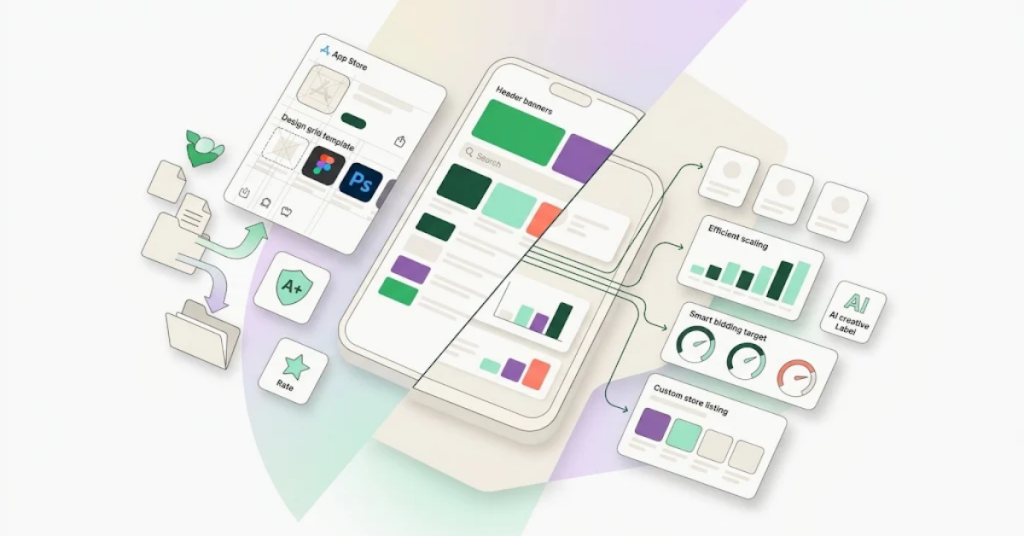
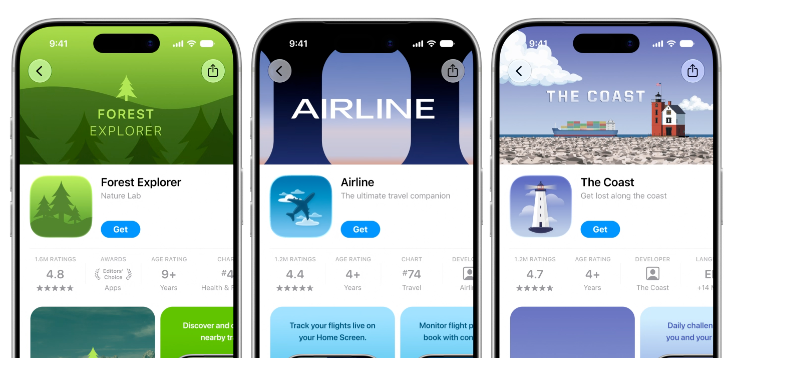
Apple dropped official design templates (Figma, Photoshop, Pixelmator) for new App Store layout formats coming this fall. Visuals are expanding beyond standard screenshot slots to include dedicated product page header assets and search result graphics.
Keep in mind that all header and search visuals must meet strict 4+ age rating guidelines, even if your app carries a higher age rating. Banners promoting prices, discounts, cross-platform badges, or aggressive imagery are strictly off-limits. To streamline operations, App Store Connect now features a centralized Asset Library, letting your team pre-upload and seek approval for creative assets independently of build deployments.
The practical effect is that organic search results become a more visual comparison, which raises the weight of store creative alongside keyword coverage.
Apple overhauls EU payment terms, effective 1 October
Apple is giving EU publishers more payment flexibility, but the cheapest-looking option isn’t automatically the best one.
The fee structure is also adjusting: Apple IAP drops to 26% (15% for Small Business Program members), alternative in-app processing is set at 20% (10% for SBP), and web or external link purchases sit at 15% (10% for SBP). Additionally, the former Core Technology Fee is being replaced by a 5% Core Technology Commission for web or alternative app store downloads.
The takeaway: a lower Apple commission is only one input. Processing fees, checkout friction, refunds and support costs still shape the real unit economics, and a single global payment strategy is unlikely to be the right call for every market from here on.
Expanded Placement Controls in Apple Ads: Apple Ads added explicit placement toggles to its management dashboard, allowing marketers to choose between Ads on the App Store and Ads on Apple Maps in the US and Canada, with plans to roll out in other markets. This offers clearer campaign control while hinting at wider ad placement expansions across Apple’s app ecosystem down the line.
Screenshot size for the new iPhone Duo dual display
Apple announced its first foldable iPhone, the iPhone Duo, on 9 September 2026, and App Store Connect’s screenshot specifications now carry a dedicated row for it. Because the device has two displays, it needs two separate screenshot sets:
- Outer display: 1398 × 2034 px (portrait) or 2034 × 1398 px (landscape)
- Inner display: 2007 × 2853 px (portrait) or 2853 × 2007 px (landscape)
One catch worth flagging to any client planning Duo-specific creative: Apple’s documentation notes that support for uploading these assets in App Store Connect won’t be available until later this year, so the sizes are published ahead of the upload capability. Worth bookmarking the dimensions now and building the asset production pipeline in parallel, so nothing’s scrambled when uploads open.
What it means for ASO teams? Whenever Apple introduces a new device format or major hardware experience, apps that adapt early often have a stronger chance of being noticed by Apple’s editorial team, similar to apps that adapted their icons early for the liquid glass icon change and were picked up by the Apple team for featuring.
Very few apps are currently built to take advantage of foldable screens, which leaves an open opportunity for early adopters. Apps that put real thought into dual-screen use and Split View, with smarter layouts, better multitasking, or a genuinely improved unfolded experience, stand a good chance of earning future App Store featuring.
Apple updates App Tracking Transparency for the EU
With iOS 27.2 and iPadOS 27.2, Apple is giving developers an alternative version of the ATT system prompt in the EU, part of its settlement with German regulators following a years-long antitrust probe. The alternative prompt has different formatting and wording, and adds an “Additional Information” button so developers can surface more context about what data they’re requesting and why. Core permission requirements stay the same.
This alternative version is mandatory, not optional, for apps distributed in Germany, France, Italy, Poland, and Romania. Elsewhere in the EU, it’s a choice.
The other change: EU users can now be re-prompted for tracking permission once a year after their last choice, regardless of whether they originally allowed or declined.
Key takeaway: if you have clients distributing in those five markets, the new prompt format isn’t optional, so it needs to be on the iOS 27.2 checklist, not a nice-to-have. For everyone else in the EU, the annual re-prompt is the more interesting lever: a “no” isn’t necessarily permanent anymore, which reopens a door for measurement and personalisation that’s been closed for a lot of apps since ATT launched.
Google Play & Google Ads Highlights
Mandatory Labels for AI-Generated Assets: Google has rolled out mandatory labeling for visual creatives generated or edited with AI across store listings and ad placements. Visual assets built with generative tools show a visible “AI” mark or watermark to maintain store transparency. Mobile teams should tag and track AI-modified visuals in their creative pipelines now to avoid unexpected review delays or listing holds.
Google Ads Target CPA / Target ROAS Bidding Behavior: Google updated smart bidding mechanics for target-based campaigns limited by budget. For budget-constrained web campaigns that previously overachieved their goals, for instance, achieving a $5 actual CPA against a set $10 Target CPA, Google Ads will now spend more aggressively to bring actual performance closer to the $10 set target.
While this change currently applies to web campaign formats (Search, Shopping, Performance Max, Demand Gen) and explicitly does not apply to App Campaigns, performance marketers running multi-touch acquisition web funnels should audit set targets immediately to prevent unexpected cost spikes.
Google play Custom store listing
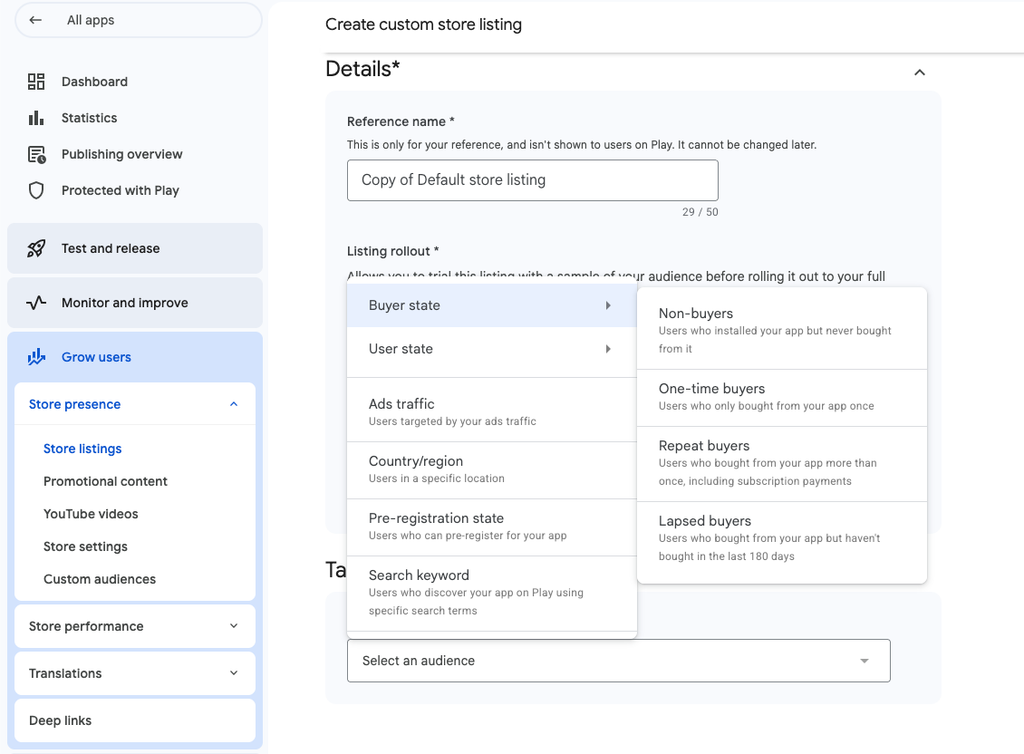
Play Console rolled out several updates to Custom Store Listings (CSLs), all aimed at tighter audience targeting and less rework.
- Custom audiences for CSLs. You can now build a dedicated custom audience for a CSL using either a CSV upload or the API, the same mechanism already used for promotional content events.
- Lapsed and churned users, split apart. These two states can now be targeted separately when creating a CSL, rather than only as a combined group.
- Per-country lapsed targeting. Lapsed users can now get dedicated CSLs by country. Previously, only one CSL could target lapsed users at all, regardless of market.
This tightens what was already a strong re-engagement tool. Splitting lapsed and churned users means you can message “come back, we’ve changed” differently from “you never actually opened the app”, and per-country lapsed CSLs matter for any app with meaningfully different feature sets or content by market.
Google Play may be reshaping the listing page
Several ASO practitioners have spotted Google experimenting with a new layout on Play Store listings. The short description gets more room, and screenshots switch to a taller portrait format. The trade-off is visibility: where users previously saw three or more screenshots before scrolling, the test surface shows just two.
Google hasn’t said whether this is an experiment or the new default. Until it does, treat your first two screenshots as the ones that carry the conversion load, and make sure the short description earns its extra space rather than just filling it.
Staying ahead of these changes
That is a lot of moving parts across both stores, and most of it lands on the same teams already running day-to-day growth. If you would like a second pair of eyes on what these updates mean for your app, feel free to reach out. We are happy to help you adapt your ASO and UA strategy to the changes that affect you.


 EN
EN  NL
NL