

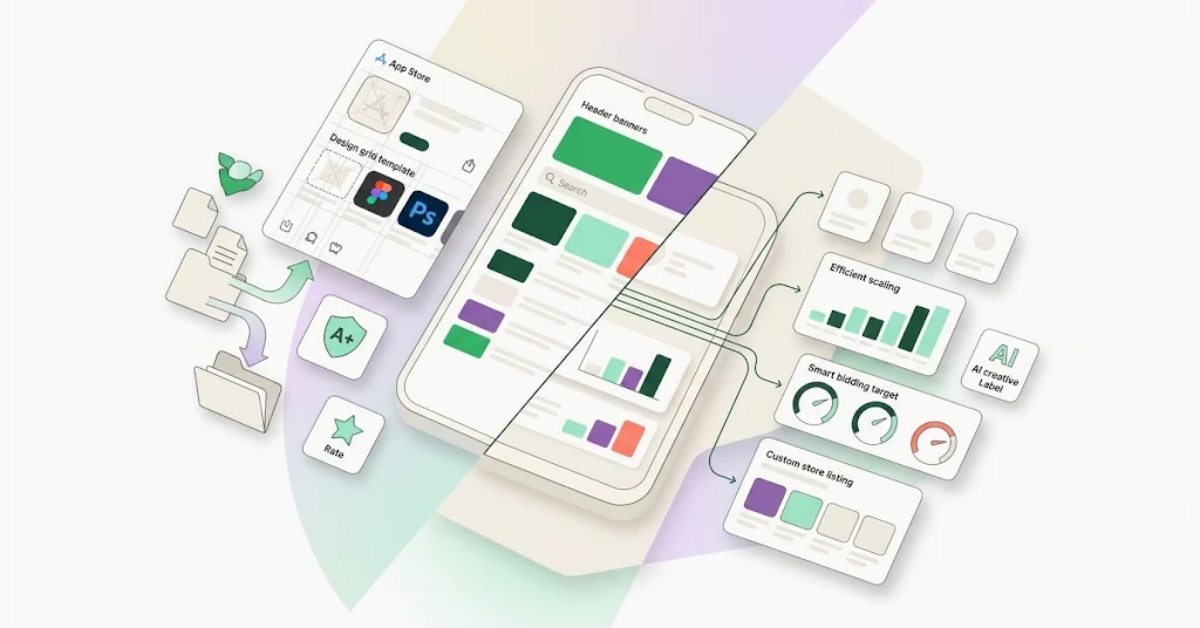
A gap between app clicks and installs is one of the most frustrating problems in app marketing, and it almost always points to something specific. When users tap through to your app store page but don’t complete the install, the issue is rarely random. It usually comes down to one of five fixable problems: a weak first impression, a vague value proposition, poor social proof, the wrong audience reaching your page, or technical friction at the final step. Identifying which of these is causing drop-off is the first step toward improving your app store conversion rate.
When clicks don’t convert to installs
The click-to-install gap is a signal worth taking seriously. A high click volume paired with a low install rate tells you that something on your app store page is breaking user confidence before they commit. The good news is that each of these five reasons has a clear fix.
1: Your app store page fails the first impression
The first screenshot, icon, and feature graphic your app shows are doing the heavy lifting before a user reads a single word. If these visuals feel outdated, generic, or inconsistent with the ad creative that drove the click, users will bounce within seconds. The visual gap between your ad and your store page creates a moment of doubt that most users won’t push through.
Your screenshots should tell a story. Show the core value of your app in the first two frames, using real UI paired with short, benefit-driven captions. The icon needs to be recognisable at small sizes and reflect your brand clearly. Preview videos, when done well, can significantly lift conversion by giving users a realistic sense of the experience before they install.
This is one of the most impactful areas of App Store Optimization (ASO) to test. A/B testing your visuals through the App Store’s product page optimisation tools or Google Play’s store listing experiments gives you direct data on what converts your specific audience, rather than relying on assumptions.
2: Your app description misses the value hook
Most users never read the full app description, but they do read the first two lines visible above the fold. If those lines don’t immediately communicate what your app does and why it matters, you lose them. A description that leads with company background, technical features, or generic claims like “the best app for X” fails to answer the one question users are asking: what will this do for me?
Your opening copy should lead with the user benefit, not the product feature. Instead of “Our app uses advanced AI to analyse your data,” try “See exactly where your money goes, in real time.” The difference is whether you’re describing your technology or the user’s outcome. The first two lines should create enough clarity and curiosity to prompt a scroll or, better, an install.
Keywords also belong here. The description is indexed by both the App Store and Google Play, so weaving in relevant search terms naturally improves discoverability while also reinforcing why your app is the right match for what the user searched for. Both goals are served by the same well-written copy.
3: Ratings and reviews are driving users away
A low average rating or a wall of unresolved negative reviews is one of the fastest ways to lose an install at the final decision point. Users treat ratings as a quick proxy for quality and trustworthiness. An app sitting below 4.0 stars faces a real conversion penalty, especially in competitive categories where alternatives are one scroll away.
The fix here is not to chase fake reviews. It is to build a system for collecting genuine feedback from satisfied users at the right moment. Prompting users after a positive in-app event, such as completing a task or reaching a milestone, dramatically increases the likelihood of a positive rating. Timing matters more than volume when it comes to review prompts.
Responding to negative reviews publicly also signals to prospective users that your team is responsive and takes quality seriously. A one-star review with a thoughtful, solution-focused reply from the developer does less damage than the same review left unanswered. Your review management strategy is part of your user acquisition funnel, whether you treat it that way or not.
4: What does a mismatched audience signal?
A mismatched audience is one of the more subtle causes of the click-to-install gap, and it often gets misread as a creative problem. When the users clicking your ads are not the users your app was built for, your store page conversion rate will suffer regardless of how well it is optimised. The clicks are real, but the intent is wrong.
This shows up most clearly in paid user acquisition campaigns. If your targeting is too broad, or if your ad creative attracts curiosity clicks rather than genuine interest, you end up paying for traffic that was never going to convert. The app install rate drops, your cost per install rises, and the underlying cause is audience misalignment rather than a page quality issue.
Reviewing your audience segments, creative messaging, and the platforms you are running on is the starting point. Different platforms attract different user profiles, and the same app can perform very differently on Meta versus Apple Search Ads versus TikTok. Matching your channel mix to the user profile most likely to install and engage is what turns click volume into meaningful growth.
5: Technical friction kills installs at the last step
Technical friction is the least visible cause of install drop-off, but it is entirely preventable. Slow load times on your store page, broken deep links, or a redirect chain that loses the user before they reach the install button all create silent exit points. Users rarely report these issues. They just leave.
App size is another factor. A large install file on a mobile connection can prompt second thoughts, especially in markets where data costs are a consideration. Some users will start the install and abandon it when they see the file size. Optimising your app’s download size, where possible, reduces this friction point.
Tracking setup also matters here. If your attribution is misconfigured, you may be seeing inflated click numbers from bots or misattributed sources, which makes your install rate look worse than it actually is. Clean attribution through platforms like Adjust, AppsFlyer, or Branch gives you an accurate picture of where real users are dropping off, so you can fix the right thing.
Close the gap and turn clicks into growth
Each of these five reasons has a clear, actionable fix. The challenge is knowing which one is causing the most damage to your app install rate right now, and having the expertise to prioritise and test improvements systematically. That is where a focused approach to ASO, audience targeting, and technical setup makes a real difference.
At Wuzzon, we work with apps across fintech, e-commerce, mobility, and more to diagnose exactly where the click-to-install gap is happening and close it. Our app growth services cover everything from store page optimisation to paid user acquisition across Apple Search Ads, Google, Meta, and TikTok, so every part of the funnel is working together. If your clicks are not converting, talk to our specialists and we will help you find out why.
Frequently Asked Questions
How do I know which of the five reasons is causing my specific click-to-install drop-off?
Start by auditing your data in layers. Check your app store analytics for where users are spending time on your page (or not), review your ad audience segments for relevance, and use attribution tools like Adjust or AppsFlyer to validate your click quality. If your ratings are below 4.0 or your first screenshot hasn’t been updated in months, those are usually the quickest wins to test first. Prioritise the fix that addresses the weakest point in your current funnel rather than trying to overhaul everything at once.
How often should I be A/B testing my app store visuals and descriptions?
A good rule of thumb is to run at least one active experiment on your store page at all times, rotating through visuals, screenshots, and copy as you gather statistically significant results. Both the App Store’s Product Page Optimisation tool and Google Play’s Store Listing Experiments allow you to test variations without disrupting your live listing. Aim to complete a full test cycle every four to six weeks, and always test one variable at a time so you can attribute performance changes to a specific element.
What's the best way to ask users for reviews without violating App Store or Google Play guidelines?
Both Apple and Google permit in-app review prompts through their native APIs (SKStoreReviewRequest for iOS and ReviewManager for Android), and using these is the compliant way to request ratings. The key is timing: trigger the prompt after a clear positive moment in the user journey, such as completing a task, hitting a milestone, or finishing an onboarding flow successfully. Avoid prompting users who have just encountered an error or expressed frustration, as this skews your ratings negatively and damages the relationship.
Can a high click-through rate on my ads actually be a warning sign?
Yes, a high CTR combined with a low install rate is a red flag that your ad creative is attracting the wrong audience. Ads that are visually striking or emotionally provocative can generate curiosity clicks from users who have no real intent to install. This is especially common with broad targeting on platforms like Meta or TikTok. Narrowing your audience targeting, refining your creative messaging to reflect the actual app experience, and monitoring post-install engagement metrics will help you distinguish quality traffic from vanity clicks.
Does app file size really impact install rates, and what can I do to reduce it?
App size has a measurable impact on install completion, particularly in markets with high mobile data costs or users on slower connections. On iOS, apps over 200MB previously required a Wi-Fi connection to download, and while this threshold has been raised, large file sizes still cause hesitation. To reduce size, work with your development team to compress image and media assets, remove unused SDKs and libraries, and consider using on-demand resources or dynamic delivery to serve only what users need at install. Even modest reductions can improve conversion in size-sensitive markets.
What's a realistic timeline for seeing improvement in app store conversion rates after making changes?
For visual and copy changes, you can begin collecting meaningful A/B test data within two to four weeks, depending on your traffic volume. Review rating improvements take longer, typically one to three months, as you build a cadence of genuine feedback from satisfied users. Technical fixes like attribution cleanup or deep link repairs can show results almost immediately once deployed. Set realistic benchmarks by category: a 5–15% lift in conversion rate from a single well-executed visual test is a strong outcome, and compounding multiple improvements over a quarter can significantly move your cost per install.
Should I optimise my app store page differently for organic search traffic versus paid ad traffic?
Ideally, yes. Users arriving from organic search have shown explicit intent through a keyword, so your page should reinforce that search context with relevant copy and visuals. Users arriving from paid ads have been interrupted by your creative, so the continuity between your ad and your store page is critical to maintaining momentum. Google Play’s Custom Store Listings and Apple’s Custom Product Pages allow you to create tailored versions of your store page for different traffic sources, letting you serve the most relevant experience to each user type without compromising your default listing.
Related Articles
- 4 reasons cost per app install isn't enough
- How do I evaluate our current app tracking vendor?
- Why do users lose their cart after reopening my app?
- What is attribution tracking in mobile app advertising?
- How do you advertise an app using influencer marketing?
- What are in-app review prompts and how do they work?
- 8 best practices for app store keyword optimization
- What is keyword density in app store optimization?
- 7 common app store optimization mistakes companies make
- How many screenshots should you have on your app store listing?


 EN
EN  NL
NL