

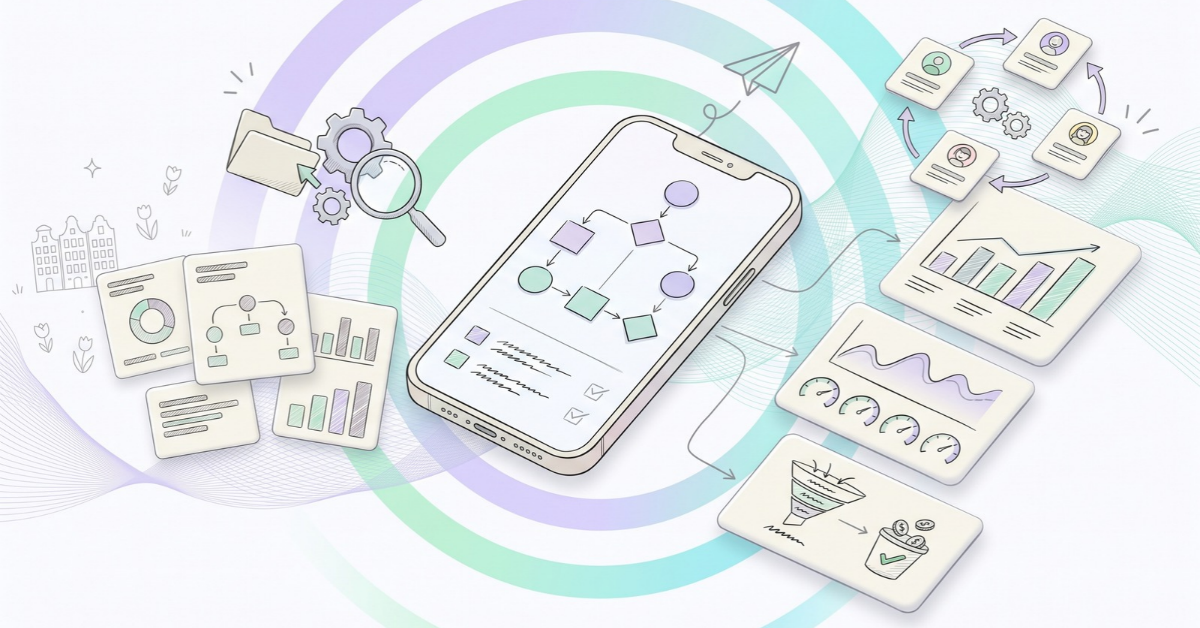
If you run paid campaigns across multiple channels, you already know the problem: your spend lives in one place, your revenue lives in another, and getting a clear picture of real app ROI means jumping between dashboards before you can make a single decision. The good news is there are practical ways to bring app ad spend and revenue into one view. Below are five approaches that actually work, from lightweight setups to fully automated reporting pipelines.
The hidden cost of fragmented app marketing data
When your app reporting is too slow or too scattered, you make decisions on incomplete information. You might pause a campaign that was actually driving paying users, or keep spending on a channel that looks active but never converts. The gap between ad spend data and revenue data is not just an inconvenience; it directly affects how efficiently you allocate budget.
Fragmented data also creates a false sense of which channel actually converts. A channel might show strong install numbers but contribute almost nothing to your cost per paying user. Without combining those signals, you cannot tell the difference. The five approaches below address this problem at different levels of complexity and cost, so you can choose the one that fits your current setup.
1: Connect a mobile measurement partner (MMP)
A mobile measurement partner is the most direct way to link ad spend to in-app revenue across every channel in one place. Tools like AppsFlyer and Singular sit between your ad networks and your app, attributing each install and in-app event back to the campaign that drove it.
Once connected, you can see cost data from Apple Search Ads, Google, Meta, TikTok, and other networks alongside revenue events like purchases, subscriptions, or registrations. AppsFlyer pulls cost data directly from connected ad networks, while Singular is particularly strong on cost aggregation and offers a unified view of spend versus return without requiring manual exports. The AppsFlyer versus Singular reporting debate often comes down to this: AppsFlyer has broader network integrations, while Singular offers cleaner cost unification out of the box.
This approach is best suited for apps running campaigns on three or more channels simultaneously. The setup requires SDK integration and some configuration time, but once live, it gives you a reliable, always-on view of your app ad spend overview without manual work.
2: Build a custom marketing dashboard
A custom dashboard gives you full control over which metrics you combine and how you visualise them. Tools like Looker Studio, Power BI, or Tableau can pull data from your MMP, ad networks, and revenue platform into a single reporting layer.
The main advantage here is flexibility. You can define your own metrics, such as cost per paying user, revenue by channel, or return on ad spend by cohort, and display them exactly how your team needs to see them. You are not limited to the views a third-party tool provides.
The trade-off is build time and maintenance. Someone on your team needs to set up and maintain the data connections, and if an API changes, the dashboard can break. This approach works well for larger teams with a dedicated analyst or data engineer, or for companies where standard MMP dashboards do not cover the specific metrics that matter most to their business.
3: Use your ad network’s built-in reporting suite
Most major ad networks now offer reporting dashboards that go beyond basic impressions and clicks. Google Ads, Meta Ads Manager, and Apple Search Ads all allow you to import conversion values or revenue signals directly from your app, giving you a spend-to-outcome view within the platform itself.
For teams running campaigns on only one or two channels, this can be enough. You connect your MMP or set up direct event tracking, and the network shows you which campaigns are driving the outcomes you care about. Meta’s value optimisation and Google’s in-app conversion tracking are both capable of surfacing real app ROI at the campaign level.
The limitation is obvious: each network only shows its own data. You cannot compare the best ad channel for your app across platforms from within a single network’s interface. If you need a cross-channel view, this approach works as a supplement rather than a standalone solution.
4: What does a performance network actually track?
A performance network operates differently from a standard ad network. Instead of charging for impressions or clicks, it charges on a fixed cost per install (CPI) or cost per action (CPA), meaning you only pay when a defined outcome is delivered. This model makes tracking straightforward because the billing event and the conversion event are the same thing.
Performance networks track installs and in-app events through your MMP, which validates every conversion before it counts toward billing. This means your spend data and your conversion data are already aligned by design. You can see exactly what you paid for each paying user without reconciling separate reports.
For app marketers who find that combining app ad reports across channels is too manual or too slow, a performance network simplifies the equation. You set the target event, agree on a price, and the network delivers verified results. It is a useful option for teams that want transparent, outcome-based spend without building a complex attribution infrastructure from scratch.
5: Automate reporting with third-party aggregation tools
Third-party aggregation tools like Supermetrics, Funnel.io, or Fivetran automatically pull data from your ad networks, MMP, and revenue sources into a central data warehouse or reporting tool. This removes the manual export step and keeps your data fresh without anyone touching it.
The main benefit is time. Instead of logging into five platforms to pull last week’s numbers, your data flows automatically into one place where you can query or visualise it. For teams managing too many marketing dashboards, this is often the most practical fix.
These tools are best suited for teams that already have a data stack in place and want to add app marketing data to it. There is typically a per-connector or per-row cost, and some platforms require technical setup. But for companies where app reporting is too slow because of manual processes, automation at this level pays for itself quickly in time saved and decisions made faster.
Choosing the right approach for your app’s scale
The right setup depends on where your app is today. If you are running campaigns on multiple channels and need reliable attribution, starting with an MMP like AppsFlyer or Singular is the most effective foundation. If you need cross-channel visibility and your team has the technical capacity, layering a custom dashboard or aggregation tool on top gives you the flexibility to track exactly the metrics that matter to your business.
For teams focused on cost per paying user and transparent spend, a performance network removes much of the reporting complexity by aligning spend and outcomes from the start. And for apps running on one or two channels with limited reporting needs, the built-in dashboards of those networks may be sufficient for now.
As your app scales, the cost of fragmented data grows with it. Getting your reporting infrastructure right early means faster decisions, better budget allocation, and a clearer answer to the question every app marketer eventually asks: which channel actually converts?
At Wuzzon, we help apps at every stage build the right growth infrastructure, from attribution setup to cross-channel campaign management. If you want to see how our app growth stack services can bring your spend and revenue data together, or if you would like to talk through your current setup, request a free consultation and we will help you figure out the right approach for your app.
Frequently Asked Questions
How do I know if my app is ready to set up an MMP like AppsFlyer or Singular?
If your app is live, running paid campaigns on at least two or three channels, and you are manually reconciling spend and revenue data, you are ready for an MMP. The key prerequisite is having a development resource available to integrate the SDK into your app, which typically takes a few days. Most MMPs offer free tiers or trial periods, so you can validate the setup before committing to a paid plan.
What is the most common mistake app marketers make when trying to combine ad spend and revenue data?
The most common mistake is treating install volume as a proxy for revenue performance. A channel can deliver thousands of installs at a low CPI while contributing almost nothing to paying users, and without connecting spend to downstream revenue events, that distinction is invisible. Always define your target conversion event — whether that is a purchase, subscription, or registration — before evaluating any channel’s performance.
Can I combine data from a performance network with data from standard ad networks in the same dashboard?
Yes, and this is actually one of the strongest use cases for aggregation tools like Supermetrics or Funnel.io. Since performance networks track installs and in-app events through your MMP, that data is already structured in a consistent format alongside your other channel data. You can pull everything into Looker Studio, Power BI, or a data warehouse and compare cost per paying user across all channels in a single view.
What if I only have one or two channels right now — is it still worth setting up a proper reporting infrastructure?
It depends on your growth trajectory. If you plan to expand to additional channels within the next six to twelve months, setting up an MMP or aggregation layer early saves significant rework later. If you are genuinely committed to one or two channels long term, the built-in dashboards of those networks combined with direct revenue tracking may cover your needs without additional tooling or cost.
How do I handle discrepancies between what my ad network reports and what my MMP reports?
Some level of discrepancy between ad network and MMP data is normal and expected, typically ranging from 5% to 20%, due to differences in attribution windows, view-through versus click-through counting, and data processing delays. The best practice is to choose one source of truth — usually your MMP — for all cross-channel decisions, and use network-reported data only for platform-specific optimisation. Documenting your attribution settings and keeping them consistent across all connected networks will minimise unexplained gaps.
What metrics should I prioritise when building a custom app marketing dashboard?
Start with the metrics that connect spend directly to business outcomes: cost per paying user, revenue by channel, return on ad spend (ROAS) by cohort, and lifetime value relative to acquisition cost. Vanity metrics like impressions and click-through rates are useful for creative testing but should not drive budget allocation decisions. Build your dashboard around the question your team asks most often — usually some version of ‘which channel is actually making us money?’ — and add secondary metrics from there.
At what point does manual reporting become too costly to ignore?
A practical rule of thumb: if your team spends more than two to three hours per week pulling, cleaning, and reconciling marketing data across platforms, the time cost already justifies investing in automation. Beyond the time itself, the real cost is decision latency — the longer it takes to produce a reliable report, the longer underperforming spend continues and the longer winning channels go under-invested. Automating your reporting pipeline with a tool like Fivetran or Funnel.io typically pays for itself within the first month.
Related Articles
- Top agencies specializing in broken app attribution and data pipelines
- 4 reasons your app retargeting ads underperform
- AppsFlyer vs Adjust: which is more accurate for app attribution?
- What is IDFA and how does it affect app tracking?
- What is the role of a mobile measurement partner in app advertising?
- How do you advertise an app using Apple Search Ads?
- 8 powerful methods to advertise your app and drive growth
- Do app preview videos increase app downloads?
- How does the app store algorithm determine rankings?
- What are custom product pages on iOS?

 EN
EN  NL
NL